












Symfony logo

Symfony: the PHP framework for custom platforms and enterprise applications

Symfony is an open-source PHP framework and a collection of decoupled components that much of the PHP ecosystem is built on – from Shopware and Akeneo PIM to Drupal. It is published by SensioLabs, a creativestyle brand. This page explains how Symfony is built, how its release cycle works, and which projects it pays off for.

What Symfony is – and what it isn't

Symfony is two things at once. First, a full-stack framework for web applications, APIs and backends. Second, a toolkit of more than 80 standalone components such as Console, HttpFoundation and Messenger, which you can use without the framework. These are the very components inside Shopware, Sylius, Akeneo PIM, Pimcore, Drupal and Laravel.

What Symfony isn't: a finished product. There's no shop, no CMS, no admin panel to click through. Symfony is the foundation you build custom software on – customer portals, integration backends, platforms with their own business logic. That's what you work with a Symfony agency for – not for installing a package.

The technical foundation

Symfony 8 requires PHP 8.4 and uses its native features instead of rebuilding them, such as lazy objects and the HTML5 parser. Three points matter for architecture decisions.

Every feature is a standalone component: HTTP, routing, security, messaging, workflows, serialisation. A dependency injection container with autowiring ties them together, configured via PHP attributes and YAML. You only install what you need.

Features that make the difference in projects

Messenger

Asynchronous processing via queues such as RabbitMQ, Redis or Amazon SQS. Ideal for imports, exports and ERP sync that mustn't block the request.

Workflow

State machines for business processes: approvals, order status, editorial flows – with clearly defined transitions instead of scattered if statements.

Security

Authentication, roles and voters for fine-grained permissions, CSRF protection and rate limiting. Signed Messenger messages since Symfony 8.

Serializer, ObjectMapper, JsonStreamer

Convert data between objects, JSON and XML. JsonStreamer handles large JSON payloads with low memory use; ObjectMapper and JsonStreamer are stable since Symfony 8.

APIs with API Platform

REST and GraphQL APIs built on Symfony, including OpenAPI documentation. The standard for headless backends.

Symfony UX and Symfony AI

Interactive interfaces with Stimulus, Turbo and Live Components, without a separate JavaScript frontend. Symfony AI adds components for AI platforms, agents, vector stores and MCP – currently still at version 0.x.

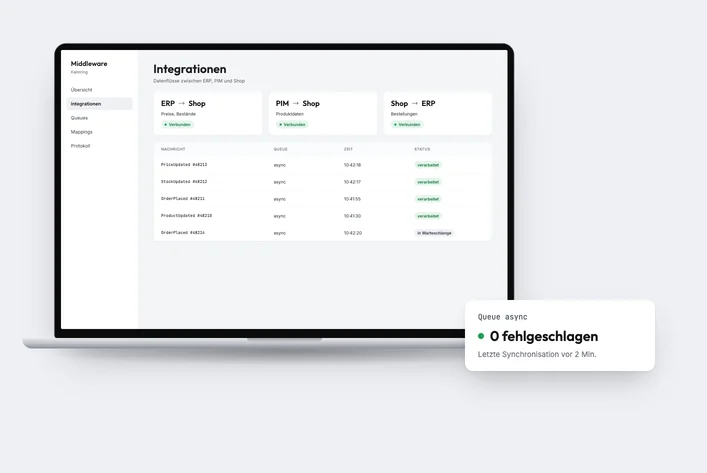
Integration dashboard syncing ERP, PIM and online shop via message queues

Symfony in the commerce stack

In e-commerce, you run into Symfony more often than you'd think. Shopware 6 is built on Symfony, and so are Sylius, Akeneo PIM, Pimcore and OroCommerce. If you know Symfony, you understand the plugins, extensions and interfaces of these systems from the inside.

Its second role: Symfony as a dedicated backend next to the shop. Integration middleware that syncs ERP, PIM and shop via Messenger queues. Customer portals with custom pricing and approval logic. Headless backends that combine content from Storyblok with product data from Shopware. That moves the effort to where it belongs: into business logic and interfaces.

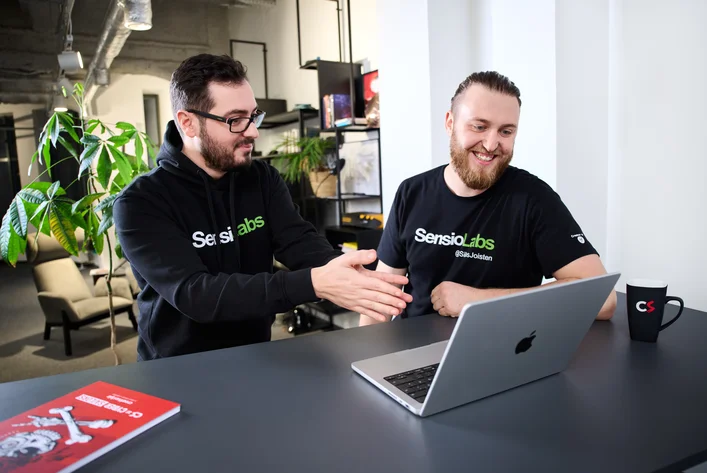
Two developers in SensioLabs shirts discussing something together at a laptop in the office

SensioLabs: Symfony expertise first-hand

SensioLabs, the publisher of Symfony, is a creativestyle brand and gives us direct access to unique PHP and Symfony expertise. Under this brand, we deliver custom development, technical leadership and best-practice architecture – from scalable platforms to complex enterprise solutions. Our team holds Symfony 7 and Symfony 8 certifications and contributes to open-source packages in the Symfony ecosystem, such as the Storyblok integration for PHP and Symfony.

Your Symfony Team

Oskar, General Manager SensioLabs
Oskar
General Manager SensioLabs
Stiven, Back-end Developer

Certifications:

Certified Symfony 7 Developer

Stiven
Backend Developer
Silas, Team Leader, Back-end Developer

Certifications:

Certified Symfony 7 Developer

Certified Symfony 8 Developer

Certified Twig 3 Designer

Microsoft Technology Associate: Database Fundamentals

Silas
Backend Developer
Jakub, Back-end Developer

Certifications:

Certified Developer Advanced

AWS Certified DevOps Engineer - Professional

AWS Certified Developer - Associate

AWS Certified Cloud Practitioner

AWS Certified SysOps Administrator

AWS Certified Data Engineer - Associate

AWS Certified Solutions Architect - Associate

Shopware 6 Certified Frontend Developer

Shopware 6 Certified Advanced Template

Shopware 6 Certified App Developer

Shopware 6 Certified Solution Architect

Shopware 6 Certified PaaS Specialist

Shopware 6 Certified Advanced Developer

Shopware 6 Certified Backend Developer

AWS Certified DevOps Engineer

Jakub
Technical Authority / Backend Development Services
Mariusz, Back-end Developer

Certifications:

Symfony 5 Certified Developer

Twig Designer

Mariusz
Backend Development Services
Michał, Front-end Developer

Certifications:

Certified Mid-Level Vue.js Developer

Certified Mid-Level React Developer

Certified Twig 3 Designer

Certified Junior React Developer

Shopware 6 Certified Frontend Developer

Shopware 6 Certified Advanced Template Designer

Shopware 6 Certified App Developer

Shopware 6 Certified Solution Architect

Michał
Frontend Development Services
Timo, Project Manager
Timo
Customer Success Manager
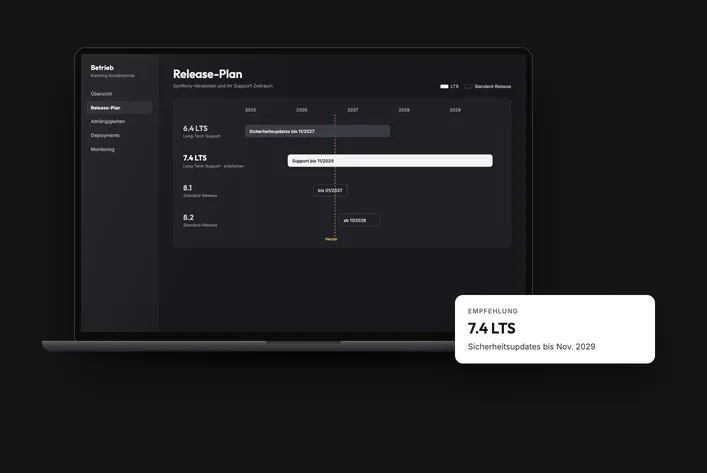
Upgrade report from Symfony 6.4 to 7.4 LTS with resolved and open deprecations

Upgrades and migration: from Symfony 4, 5 or 6 to 7.4 LTS or 8

Symfony upgrades are predictable because every change is announced one version earlier as a deprecation. Once all deprecation warnings are fixed, you can move to the next major version without further code changes. Tools such as Rector, PHPStan and SymfonyInsight upgrade reports show the effort up front.

The real work lies in dependencies: third-party bundles that don't keep up, and custom code that relies on removed APIs. For legacy applications – old PHP systems or WordPress landscapes, say – we extract features step by step instead of rebuilding everything at once. That's where an honest audit before kick-off pays off.

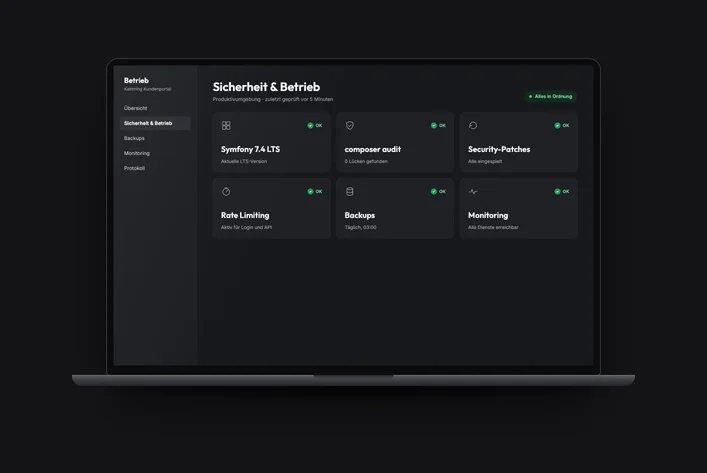
Dashboard showing the security and operations status of a Symfony application

Security, hosting and operations

Symfony discloses vulnerabilities through a fixed process, with advisories and patches for all maintained versions. composer audit automatically checks your dependencies against known vulnerabilities – ideally in every CI pipeline.

Symfony runs wherever PHP runs: on your own servers, in Docker and Kubernetes, or on PaaS providers such as Upsun. Patch level, monitoring and backups remain your responsibility – or your service provider's.

Who Symfony is right for

Symfony is a good fit if at least one of these applies:

  • Your business logic doesn't fit any off-the-shelf product.

  • You need a backend that reliably connects ERP, PIM, shop and CMS.

  • Your application needs to be maintained for ten years or more.

  • You already use Shopware, Akeneo or Pimcore and want to extend them deeply.

  • You want full control over code, data and hosting – with no licence fees for the framework.

If you need a website with standard features or an off-the-shelf shop, Symfony on its own is the wrong starting point. We'll tell you that in the first call, too.
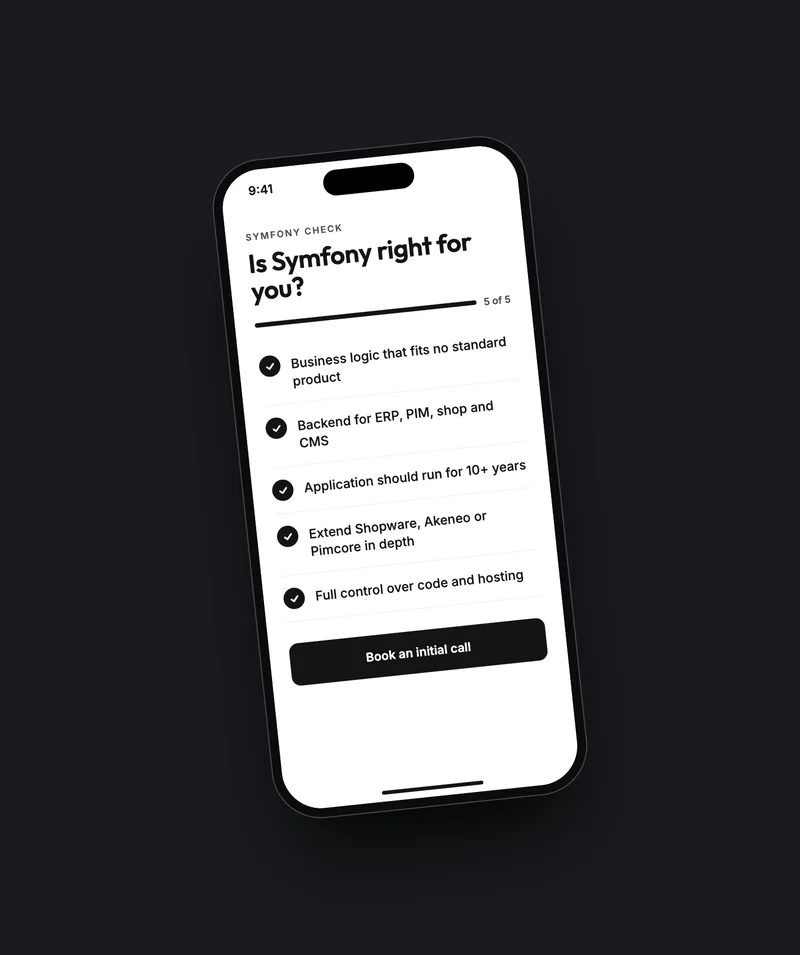

Smartphone showing a “Is Symfony right for you?” checklist with five criteria met, in front of a white brushstroke

Our Current Symfony Projects

Discover how we build powerful, modular and maintainable web applications with Symfony – tailored solutions that deliver performance, precision and long-term stability.

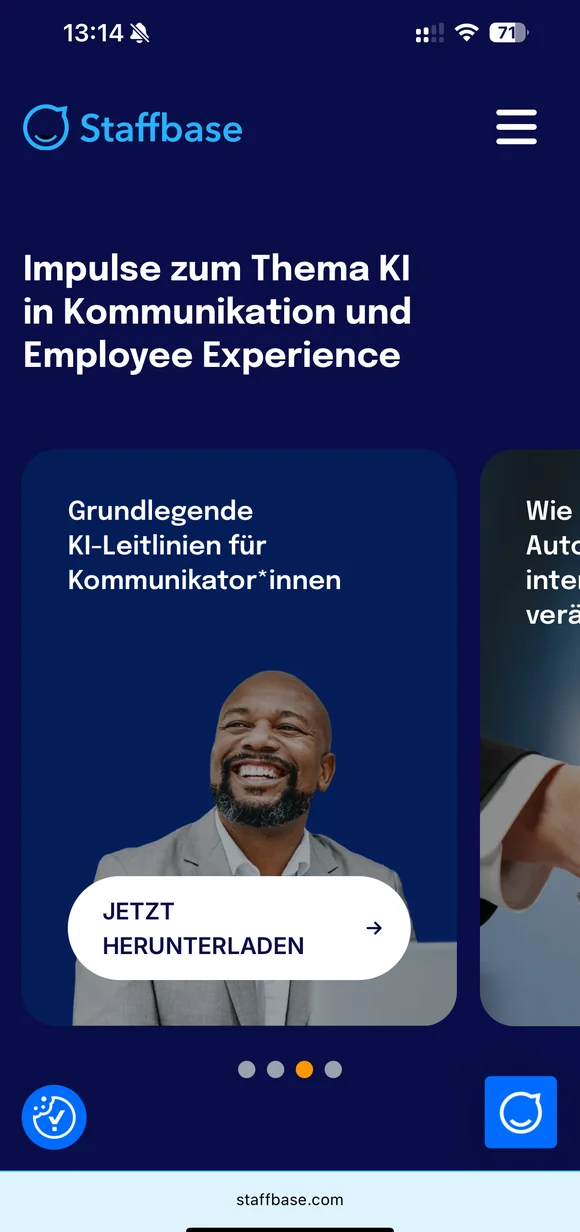
Staffbase mobile e-commerce interface showcasing AI guidelines for communicators and employee experience resources

Staffbase

Staffbase is a corporate communication platform that connects employees via an intranet portal or mobile app. It enables engagement, news delivery, and knowledge sharing for distributed organizations.

  • Fragmented, insecure WordPress landscape across multiple instances

  • Poor scalability and performance for rapid international growth

  • Inefficient workflows due to lack of uniform component structures

SensioLabs mobile interface showcasing architectural workshops and Symfony project services

SensioLabs

As the creator of the PHP Framework Symfony, SensioLabs provides expert consulting, architecture design, migration, and support for companies leveraging Symfony and various open-source technologies.

  • Relaunching international platform on modern Symfony/Headless CMS architecture

  • Implementing fully automated CI/CD pipelines for builds and deployments

  • Maintaining performance and code quality across complex system integrations

CEWE mobile e-commerce interface showcasing various photo book formats, including "Groß" and "Groß Panorama," with pricing and descriptive details for personalized photo products

CEWE

Europe’s leading photo service, CEWE Group, has entrusted us with the CEWE Photo Award platform for 10+ years, growing it into the world’s largest community photo competition.

  • The CEWE Photo Award is the world's largest community photo competition

  • Open competition for professional and amateur photographers

  • High demands on stability and performance at peak times

FAQ

If you can upgrade every six months, use the current 8.x release. If you need a long support window, go with Symfony 7.4 LTS, with bug fixes until November 2028 and security fixes until November 2029.

Benedikt, Director Partnership and Growth

Would You Like to Talk About Your Project?

With our creative approach, we support our clients' success.
Feel free to contact us!

Benedikt Merl

Director Partnerships & Growth