Agentic Commerce: get your shop ready for AI agents
AI assistants such as ChatGPT, Gemini and Copilot increasingly search, compare and buy on behalf of their users. They recommend the shops whose products they can find, understand and order safely.
Find out where your shop stands in under a minute – free and without signing up.
Agentic commerce and agentic readiness
Two terms that belong together: one describes how shopping is changing, the other whether your shop is ready for it.
-
What is agentic commerce?
Commerce in which AI agents prepare purchase decisions or carry them out themselves. Instead of opening 10 tabs, your customer says: “Find me running shoes in size 42 under €150.” The agent searches shops, compares prices, availability and reviews and, ideally, adds the product straight to the cart. Book a call -
What is agentic readiness?
Your shop's ability to be found, understood and used by AI agents. That includes open crawler rules, complete structured product data, content that's readable without JavaScript and ways for an agent to buy or enquire. Our Agentic Readiness Check measures exactly that. Start the check -
Which protocols are behind it?
ACP: by OpenAI and Stripe. Agents create carts and pay right in the chat. UCP: by Google and Shopify. Open standard for agents to access products, checkout and payment across shops. MCP: originally by Anthropic. Connects AI assistants to systems such as your shop's catalogue, stock or order status. Discuss protocols
The Agentic Readiness Check looks at three levels
Our free check reads your shop the way AI agents do: without logging in and without JavaScript. It checks robots.txt, sitemaps and structured data. You get a score and concrete recommendations on where to start.

Discoverability
Are agents allowed to find your pages and products, and can they? Crawler access, sitemaps and indexability.

Readability
Do agents understand your products, and can they compare them? Structured data, prices, availability and server-rendered content.

Actionability
Can an agent act for your customers – buy, enquire, get in touch – and can it trust you while doing so?
The shift is measurable
Search is moving into AI assistants, and AI traffic is becoming a revenue channel.
58%
fewer clicks on top-ranking pages when an AI Overview appears
40%
higher conversion from AI traffic than other channels on Prime Day 2026
20%
of digital commerce transactions will run through AI platforms or agents by 2030, Gartner forecasts
72%
of retailers don't feel ready for agentic commerce
Why agentic readiness matters now
If agents can't see you, you're out of the shortlist before a person ever sees your shop.
On Prime Day 2026, visitors arriving via AI links converted 40% better than other channels – a year earlier, they had converted 23% worse (Adobe).
Open protocols such as the Agentic Commerce Protocol (ACP) by OpenAI and Stripe or the Universal Commerce Protocol (UCP) by Google and Shopify let agents create carts and pay – right in the chat.
27% of ChatGPT messages are work-related (OpenAI/NBER). Buyers have long been researching suppliers, specifications and prices with AI.
72% of retailers don't yet feel ready for agentic commerce (Salesforce). Getting set up properly now gives you a head start.
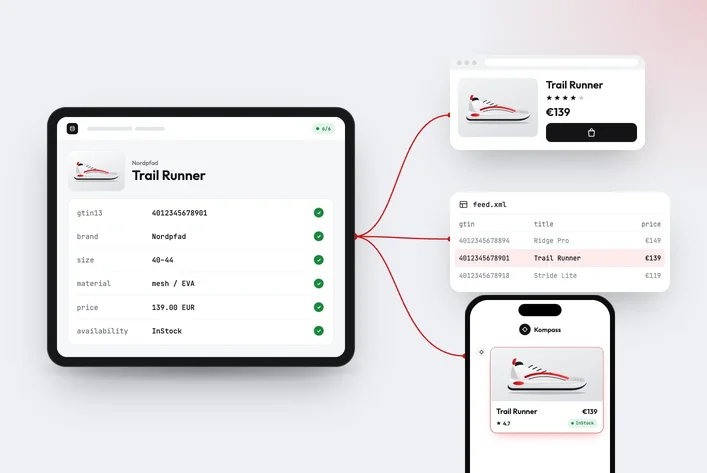
Product data is the new shop window
An agent doesn't see images or campaigns. It reads data. The more complete and unambiguous your product data is, the more likely your product is to appear in the answer.
Unique identifiers: GTIN, brand, manufacturer part number
Complete attributes: size, material, dimensions, compatibility – structured rather than buried in body copy
Current prices and availability from a single source, with no contradictions between page and feed
PIM as the foundation: a PIM such as Pimcore or Akeneo feeds your shop, feeds and agents from one clean data source
Schema.org, feeds and crawler rules: the technology behind it
Structured data is the language agents use to read your shop. These are the key building blocks.

Product and Offer
Name, identifiers, price, currency and availability as Schema.org markup. A must for every product comparison.

Shipping and returns
OfferShippingDetails and MerchantReturnPolicy. Agents weigh delivery time and return conditions just like price.

Reviews and organisation
AggregateRating, Review and Organization build trust – the basis for an agent recommending you.

Product feeds
Google Merchant Center and the AI platforms' feeds, built from one consistent data set for all channels.

robots.txt and AI crawlers
Decide deliberately which bots such as GPTBot, OAI-SearchBot or PerplexityBot may crawl what – instead of locking them out by accident.

Server-side rendering
Many agents don't execute JavaScript. Anything that only loads client-side doesn't exist for them.
From check to agent-ready shop
The check shows you where you stand. We help you close the gaps – on your platform and at your pace.
Step 1
Check
The free Agentic Readiness Check as a starting point.
Step 2
Analysis
We go through the results together and prioritise by effort and impact.
Step 3
Implementation
Structured data, feeds, crawler rules, product data in the PIM and interfaces for agents.
Step 4
Monitoring
Measure AI traffic and visibility and keep refining.
FAQ'S
Agentic commerce is commerce in which AI agents search for, compare and buy products on behalf of users. To take part, retailers need machine-readable product data, clear crawler rules and interfaces through which agents can place orders.
Agentic readiness describes how well an online shop is prepared for AI agents: whether agents are allowed to and can find it, whether they understand products, prices and availability, and whether they can buy or enquire on behalf of users. creativestyle's free Agentic Readiness Check gives you a score for this in under a minute.
Agentic commerce is the development in the market: AI agents search, compare and buy on behalf of people. Agentic readiness is the state of your shop: how well it is prepared for this development. In short, agentic commerce is happening anyway – agentic readiness decides whether you benefit from it.
SEO optimises for search engine rankings, GEO (generative engine optimisation) for being mentioned in AI assistants' answers. Agentic commerce goes one step further: the agent should not just talk about you but be able to buy from you.
The check reads your shop like an AI agent – without logging in and without JavaScript – and rates discoverability, readability and actionability. Among other things, it checks robots.txt, sitemaps and structured data. It's free and delivers a score with recommendations in under a minute.
The basis is Product and Offer with price, currency, availability and identifiers such as GTIN. OfferShippingDetails, MerchantReturnPolicy, AggregateRating or Review and Organization also matter.
It's a deliberate decision. If you lock out search and assistant bots such as OAI-SearchBot, you won't appear in their answers. A differentiated rule makes sense: allow bots that bring you visibility and specifically restrict what you don't want to share.
llms.txt is a proposal for a file that gives language models a compact overview of a website. It isn't an official standard. Structured data, clean feeds and server-readable content have a much bigger impact.
Yes. Buyers increasingly research suppliers, specifications and prices with AI. Especially in B2B, with complex product data, data quality decides whether an agent classifies your product correctly.