Logo Shopify

Shopify: the SaaS commerce platform for brands, B2B and headless commerce

Shopify is a SaaS commerce platform by Shopify Inc. from Canada. Shopify runs hosting, security, updates and checkout itself – you focus on your range, your brand and your extensions. This page explains how Shopify is built, where its limits are, and who the platform pays off for.

What Shopify is – and what it isn't

Shopify is a fully hosted shop system: catalogue, storefront, checkout, payments, markets and apps on one platform. You don't install, patch or scale servers. Shopify Plus adds enterprise features: a customisable checkout, B2B, multiple stores and higher API limits.

What Shopify isn't: a system where you change the core. Custom logic is built with apps, Shopify Functions and APIs – within the platform's rules. As soon as ERP, PIM or custom pricing logic come into play, the shop setup becomes an integration project. That's what you work with a Shopify agency for – not for setting up a theme.

The technical foundation

Shopify is a multi-tenant SaaS platform: all merchants run on the same codebase and receive new features automatically. Three points matter for architecture decisions.

The Admin API for backend and integrations, the Storefront API for custom frontends, the Customer Account API for customer accounts. Since April 2025, new public apps must use GraphQL. A new API version ships every three months and each is supported for at least twelve months – so updates are a fixed part of operations.

Plans, Shopify Plus and operating models

Shopify always runs as SaaS. The choice is about the plan and the frontend – and therefore about how much customisation you need.

Standard plans

For brands with one store and a standard checkout. Fast start, theme plus apps, extensions within the plan's limits.

Shopify Plus

From US$2,300 per month on a one- or three-year term. Customisable checkout, B2B with unlimited catalogues, up to nine expansion stores, up to ten times higher limits on selected APIs.

Headless with Hydrogen and Oxygen

A custom React frontend via the Storefront API, hosted on Oxygen or anywhere else. Shopify Plus allows up to 25 headless storefronts.

Updates and versions

Shopify updates the platform itself. What matters for you are API versions, theme updates and app compatibility – predictable every three months.

Features that make the difference in projects

Shopify Markets

Countries, currencies, languages, domains and prices per market from one store, including local payment methods.

B2B on Shopify

Company accounts with locations, customer-specific catalogues and price lists, payment terms and quick order – in Shopify Plus.

Checkout extensibility

Checkout UI extensions and Functions instead of custom checkout code. Updates stay compatible, and Shop Pay is built in.

Shopify Flow

Automation based on shop events: tagging orders, flagging stock levels, passing data to third-party systems.

Point of sale

Stores and online shop on one system: shared stock, customers and orders for true omnichannel.

Sidekick and AI

AI assistance in the admin for reports, copy and shop tasks via natural language.

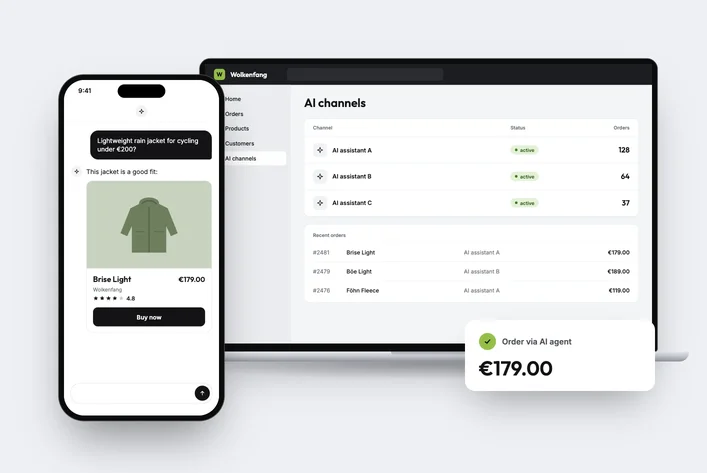
Smartphone with an AI assistant recommending a product with direct checkout, and a laptop behind it showing an overview of AI sales channels

Shopify and agentic commerce

AI agents are becoming a shopping channel. For this, Shopify developed the Universal Commerce Protocol (UCP) together with Google: an open standard that lets agents find products, use a merchant's checkout and complete orders. Supporters include Etsy, Wayfair, Target and Walmart.

For you, that means clean product data, structured attributes and a standards-compliant checkout decide whether agents can recommend your products at all. That's where we come in – from data model to checkout logic.

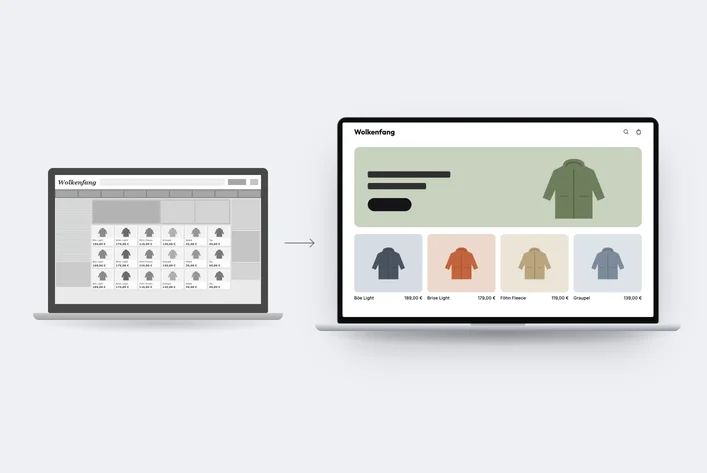
Before-and-after comparison of an outdated online shop and the brand's new, modern shop

Migration: from Magento, Shopware or Shopify Scripts

When replatforming from Magento, Shopware or a custom build, import tools transfer products, customers and orders. What doesn't come across: special logic buried in the old system's code. It has to be rebuilt as an app, Function or middleware – or deliberately dropped. On top of that, you need a complete redirect map so rankings survive the move.

There are mandatory migrations within Shopify too: Shopify Scripts stopped running on 30 June 2026, and old checkout.liquid code has been replaced. If you still carry legacy, you need an honest audit before the next project step.

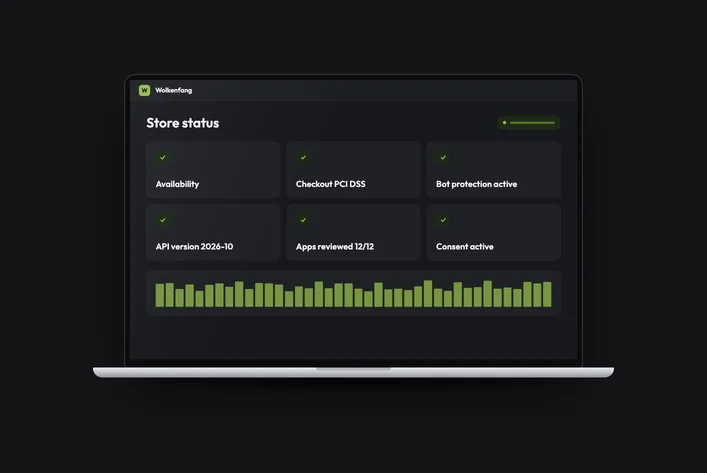
Dashboard showing a Shopify store's operating status: availability, PCI DSS checkout, bot protection, API version, reviewed apps and consent

Security, hosting and compliance

As SaaS, Shopify takes care of hosting, scaling, patches and the PCI DSS compliance of checkout. The platform absorbs traffic peaks such as sales or product launches, and Shopify Plus adds bot protection and a checkout built for high volume.

The flip side: you don't choose the server location or infrastructure yourself. For GDPR, data processing agreements, consent management and app selection therefore matter – every app is another data recipient. We review this with your data protection team before go-live.

Who Shopify is right for

Shopify is a good fit if at least one of these applies:

  • You want to go live fast without running your own infrastructure.

  • Your brand and customer experience come first.

  • You sell internationally across several markets and currencies.

  • Your B2B business works with standard B2B features.

  • You want to serve new channels such as social, POS and AI agents from one system.

If your pricing and process logic must sit deep in the core, or you need full control over hosting and code, Shopware or Magento are often the better choice. We'll tell you that in the first call, too.
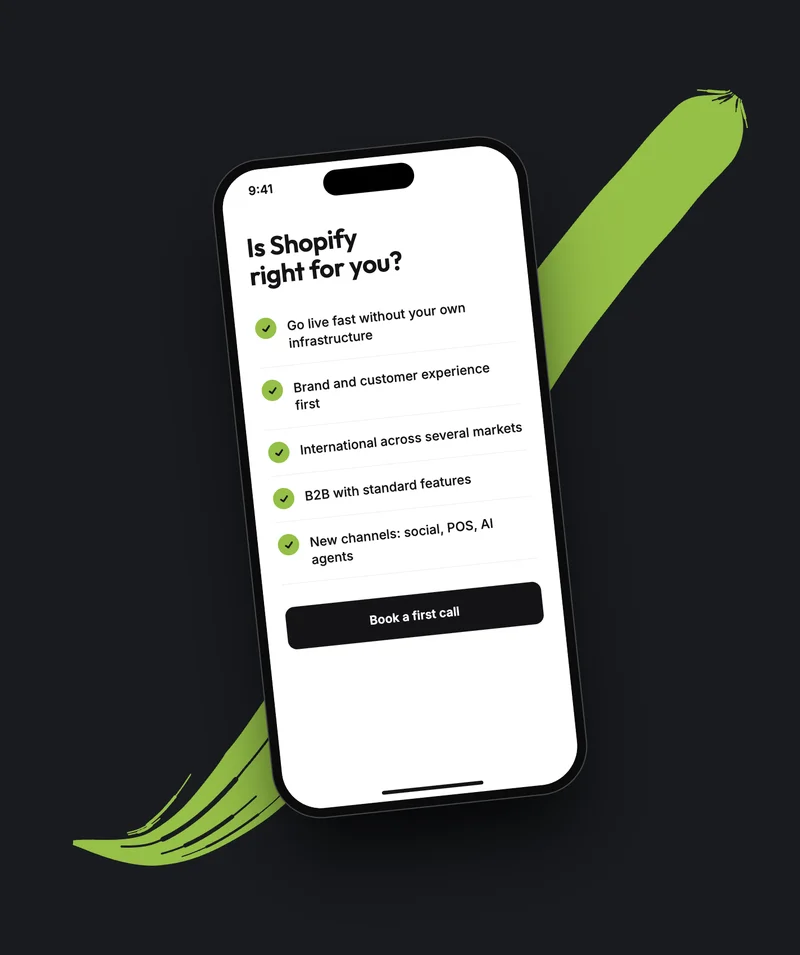
Smartphone showing a "Is Shopify right for you?" checklist with five criteria met, in front of a green brushstroke

Your Shopify Team

Rafał, Front-end Developer

Certifications:

Liquid Storefront for Theme Developers

Adobe Commerce Front-End Developer

Rafał
Frontend Development Services
Hüseyin, Project Manager

Certifications:

Baymard Institute Tier 2: UX Professional

Hüseyin
Project Manager
Joanna, QA Engineer

Certifications:

Certified Tester Foundation Level

Joanna
Quality Chapter Coordinator
Christian, Director of Client Success

Certifications:

Specialist eCommerce Optimization

Specialist Landing Page Optimization

Baymard Institute Tier 2: UX Professional

Christian
Director of Client Success
Konrad, Front-end Developer

Certifications:

Shopify Development Fundamentals

Vue.js Developer Level 1

Vue.js Senior Developer II

Konrad
Frontend Development Services
Marieta, Front-end Developer

Certifications:

Liquid Storefronts for Theme Developers

Marieta
Frontend Developer

Our certificates

Shopify Selling Fundamentals certification badge

Selling Shopify
Fundamentals

Shopify Development Fundamentals certification badge

Shopify Development Fundamentals

Shopify Solution Planning Fundamentals certification badge

Solution Planning Fundamentals

Shopify Selling Fundamentals certification badge

Selling Shopify
Fundamentals

Shopify Development Fundamentals certification badge

Shopify Development Fundamentals

Shopify Solution Planning Fundamentals certification badge

Solution Planning Fundamentals

Shopify Selling Fundamentals certification badge

Selling Shopify
Fundamentals

Shopify Development Fundamentals certification badge

Shopify Development Fundamentals

Shopify Solution Planning Fundamentals certification badge

Solution Planning Fundamentals

Our current Shopify projects

See how we create high-performing, scalable and brand-driven e-commerce experiences with Shopify – uniting conversion, design and technology seamlessly.

Gemini said BIKE MARKET mobile e-commerce interface showcasing the "CUBE Reaction Hybrid Race" electric mountain bike in "lizard´n´black" color, including product images, a deal badge, and customer ratings

BIKE Market

For leading retailer BIKE Market, we developed a high-performance Shopify solution. The store combines speed, usability, and modern design, optimized for growth, flexibility, and a seamless shopping experience.

  • Outdated e-commerce platform with extensive effort required for maintenance and further development

  • Weaknesses in performance, accessibility, and SEO

  • Managing extensive bike variants and accessories within intuitive structures

FAQ'S

Shopify is a SaaS commerce platform. Shopify runs hosting, security and updates; merchants shape their storefront, range and processes with themes, apps and APIs.

Benedikt, Director Partnership and Growth

Want to talk about your Shopify project?

Whether it’s a new shop, a relaunch, or scaling: Let’s see if Shopify is the right platform for your goals.

Benedikt Merl

Director Partnerships & Growth