
Akeneo logo

Akeneo: the PIM for product data that powers your shop, marketplaces and AI

Akeneo is a product information management (PIM) system from France and today the core of the Akeneo Product Cloud. It brings product data together in one place, enriches it and distributes it to your shop, marketplaces and AI channels. This page explains how Akeneo is built, which editions and modules it offers and who the system pays off for.

What Akeneo is – and what it isn't

Akeneo is the central source for product information: attributes, variants, categories, translations and media. Families and attribute rules define the structure, while completeness checks and workflows ensure quality. Your shop, marketplaces, print and feeds draw their data from this one system.

What Akeneo isn't: a shop system, an ERP or a pure asset management tool. Prices, stock and orders stay in your ERP and shop. Akeneo makes sure every product is described completely, correctly and consistently everywhere.

The technical foundation

Akeneo today relies on SaaS and an open interface landscape. Three points matter for architecture decisions.

The REST API is the basis for integrations with your shop, ERP and marketplaces. There is also a GraphQL API and the Event Platform, which reports product changes via webhook. The older Events API is deprecated.

The Akeneo Product Cloud

Around the PIM, Akeneo offers further modules. You combine them depending on your data flow: from suppliers through enrichment to distribution.

PIM

Central management and enrichment of product data with families, variants, workflows and completeness rules.

Supplier Data Manager

Onboard supplier data and normalise it with AI extraction before it enters the PIM.

Activation

Distribute product data to retailers and marketplaces. Akeneo cites more than 500 connected channels.

DAM, Shared Catalogs and PX Insights

Manage product media, share catalogues with partners and analyse how product content lands with customers.

Features that make the difference in projects

Data model with families and variants

Families define which attributes a product needs. Variants cover sizes, colours and versions.

Completeness and quality rules

Completeness checks per channel and language show which products aren't yet ready to be published.

Workflows and roles

Approval processes and permissions, so many teams can work safely on the same catalogue.

Multiple languages and channels

Maintain values per language and channel, for example different copy for shop, marketplace and print.

AI enrichment

Generative AI for copy and images, optionally with your own language model for more governance.

Categories and catalogues

Multiple category trees for different channels and targeted catalogues for individual apps or partners.

Our certificates

Akeneo Business Implementation 6.0 certification badge

Akeneo Business Implementation 6.0

Akeneo Technical Integration 6.0 certification badge

Akeneo Technical Integration 6.0

Akeneo Foundation certification badge

Akeneo Foundation

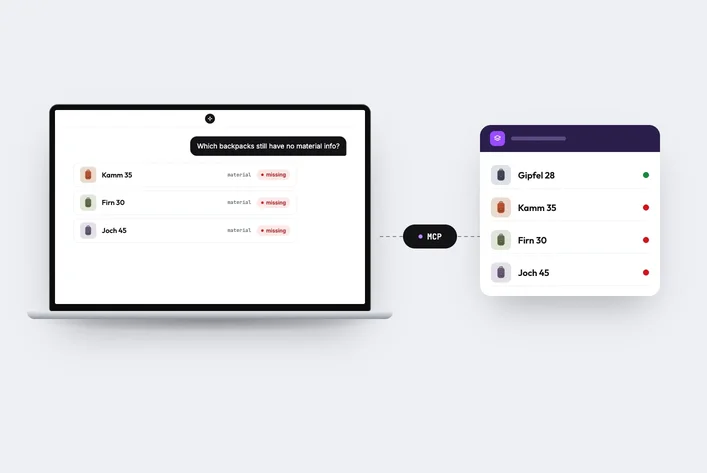
AI tool connected via MCP lists products with missing material data from the PIM

Akeneo and agentic commerce

AI agents only buy what they understand. That makes the PIM the most important data source for agentic commerce.

  • Akeneo MCP Server: connects the PIM to AI tools that support the Model Context Protocol. You can search, create, update and compliance-check products in natural language.

  • Agentic Product Intelligence: agents in Akeneo find gaps and inconsistencies in product data.

  • Agentic commerce protocols: Akeneo cites support for protocols that AI assistants use to retrieve product data.

Our free Agentic Readiness Check shows where your shop stands today.

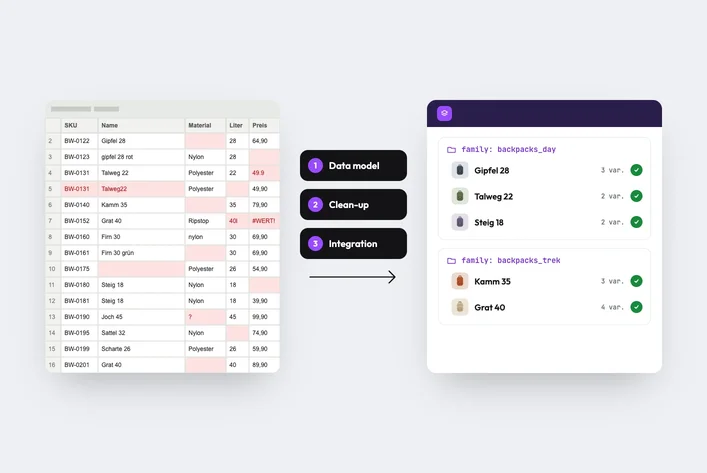
Messy spreadsheet turned into structured product data in a PIM

Migration: from Excel, a legacy system or the Community Edition

Most Akeneo projects start with spreadsheets, a grown legacy system or a Community Edition that is now being phased out. This approach has proven itself:

  • Data model first: define families, attributes and variants properly before data flows.

  • Clean up data: resolve duplicates, units and mandatory fields instead of carrying old baggage over.

  • Plan integrations: ERP as the source for master data, shop and marketplaces as targets, connected via API or apps.

  • Onboard teams: set roles, workflows and completeness rules with the business teams.

For a Community Edition, we check upfront which customisations live on in the SaaS world as apps or extensions.

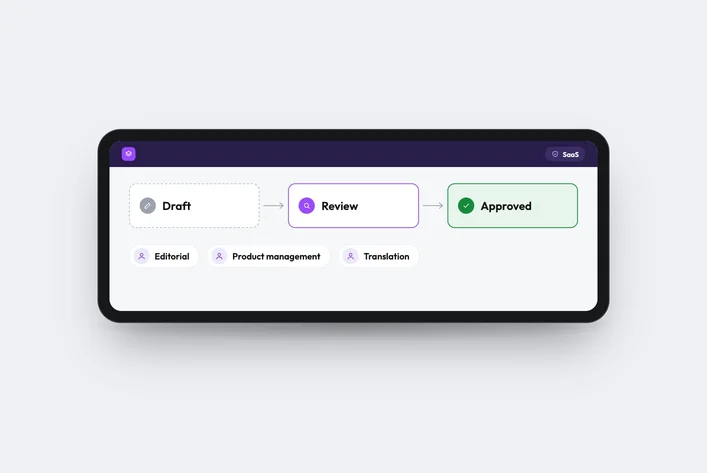
Governance view with approval workflow and user roles

SaaS, security and governance

The current Akeneo editions run as SaaS: Akeneo takes care of hosting, updates and scaling. New features arrive continuously, without upgrade projects like those for the self-hosted Community Edition.

Governance is built into the system: roles and permissions, approval workflows, completeness rules and, for AI enrichment, the option to connect your own language model.

Please check certifications and data locations directly with Akeneo before signing a contract.

Who Akeneo is right for

Akeneo is a good fit if several of these apply:

  • You have many products, variants or attributes.

  • You sell through several channels, countries or languages.

  • Product data comes from suppliers or several systems and is inconsistent today.

  • You want to prepare product data for AI and agentic commerce.

For a small, stable range, managing data in the shop is often enough. We help you clarify this properly upfront.


Smartphone with an "Is Akeneo right for you?" checklist

Our current Akeneo Projects

See how we use Akeneo to create efficient, centralised and scalable product data solutions that keep your commerce platforms consistent across all channels.

Shop usability award

Benuta

Benuta is Europe’s leading online retailer for rugs and home décor. The company merges modern design with cutting-edge technology, relying on a scalable headless architecture to drive flexibility, automation, and international expansion.

Benuta was awarded in the category "Best Customer Experience" at the Shop Usability Award 2026 for its outstanding shopping experience.

  • Complex system landscape with high order volume

  • Balanced product presentation, description, and service to reduce returns

Babyartikel.de e-commerce website preview on two mobile devices showcasing travel beds and the Pinolino Yuma play tent among baby toys and accessories

Babyartikel

Babyartikel.de is a leading online retailer for baby and toddler gear in the German-speaking region. With a wide range, fast shipping, and expert advice, the company supports parents in choosing the perfect essentials.

  • Migrating long-standing store without disrupting daily sales

  • Refactoring legacy customizations while preserving business logic

  • Optimizing speed for massive catalogs and categories

  • Balancing UX improvements with conversion-driven brand expectations

FAQ'S

Akeneo is a product information management (PIM) system from France. It centralises product data, enriches it and distributes it to your shop, marketplaces and other channels. Today it is part of the Akeneo Product Cloud.

Benedikt, Director Partnership and Growth

Would You Like to Talk About Your Project?

With our creative approach, we support our clients' success.
Feel free to contact us!

Benedikt Merl

Director Partnerships & Growth