Storyblok Logo

Storyblok: the headless CMS with a Visual Editor for content and commerce

Storyblok is an API-first headless CMS built by Storyblok GmbH in Linz, Austria. It separates content from presentation and delivers it via API to your website, shop, app or any other channel – while editors see exactly what they're building in the Visual Editor. This page explains how Storyblok works under the hood, how it fits with Shopware, Magento and Symfony, and which projects it pays off for.

What Storyblok is – and what it isn't

Storyblok is a content management system without a frontend of its own. Content is created as structured components, stored in the cloud and delivered via REST and GraphQL APIs. Which frontend renders it – Next.js, Nuxt, Astro, a Symfony application or your shop's storefront – is up to you. Storyblok itself runs as SaaS only.

What Storyblok isn't: a website builder with ready-made themes. No frontend, no page. No clean content model, no structure. That's why every Storyblok rollout is an architecture project: defining components, building the frontend, connecting systems. And that's what you work with a Storyblok agency for – not for creating pages.

The technical foundation

Storyblok is a cloud platform running on AWS, with separate APIs for delivery and management. Three points matter for architecture decisions.

The Content Delivery API serves published and draft content via REST, cached through a CDN. A GraphQL API lets you query exactly the fields you need. The Management API writes content, component schemas and assets – the route for migrations, bulk imports and CI/CD.

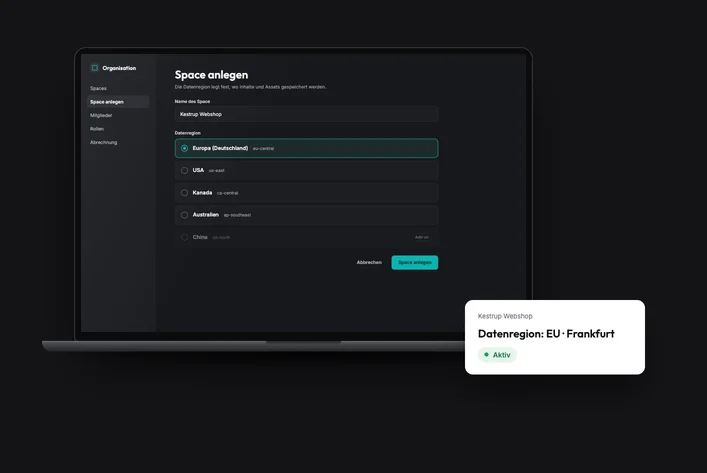
Einstellungsseite eines CMS mit Auswahl der Datenregion, Europa ist ausgewählt

Hosting, data regions and plans

Storyblok is available as SaaS only – self-hosting isn't an option. In return, you choose the data region: Europe (Germany), USA, Canada or Australia, with China as an add-on. Your space then lives entirely in that region.

Plans range from the free Starter tier through Growth and Growth Plus to Premium and Elite. They differ mainly in seats, languages, API quota, uptime SLA and enterprise features such as SSO, custom roles and custom workflows. Your frontend is hosted separately – with a hosting partner, on platforms such as Upsun or Vercel, or on your own infrastructure.

Features that make the difference in projects

Visual Editor & preview

Editors change content directly on the page and see drafts before they go live.

Internationalisation

Field-level translation within a story, or folder-level translation for standalone country content; untranslated fields fall back to the default language.

Workflows & releases

Approval stages from draft through review to publishing; releases bundle changes for a joint go-live.

Roles, permissions & SSO

Standard roles on every plan; from Premium, custom roles with permissions per folder, component or language, plus SSO, SCIM and enforced two-factor authentication.

Extensibility

Webhooks for events such as publishing, field plugins for custom input fields, and apps for integrations, for example picking products from your shop.

AI & automation

AI translation, alt text and copy suggestions in the editor; FlowMotion (launched 2026, built on n8n) is an add-on for automating content processes

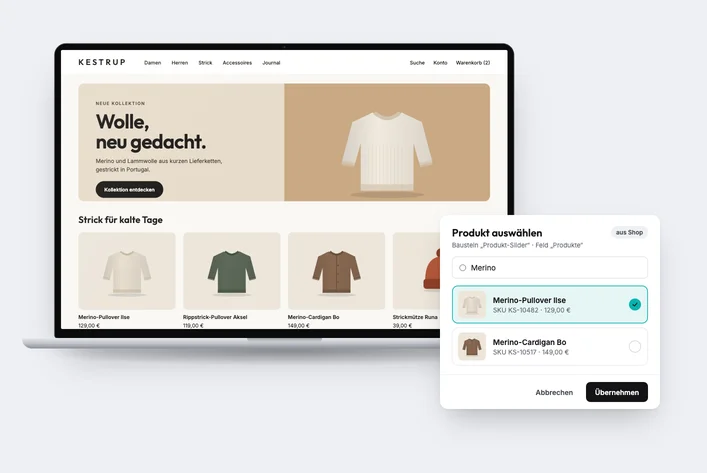
Onlineshop mit redaktioneller Kampagne und Produktkacheln, daneben eine Produktauswahl aus dem Shopsystem im CMS

Storyblok in the commerce stack

The strongest case for Storyblok in e-commerce is a clear division of labour. The shop system – Shopware, Magento or commercetools – handles products, prices and checkout. Storyblok handles everything that tells a story: landing pages, campaigns, guides, brand worlds. Product data stays in the shop or PIM; editors reference products in Storyblok instead of copying them.

Both come together in the frontend, which loads content from Storyblok and product data from the shop API. That moves the effort to where it belongs: into the content model and the interfaces.

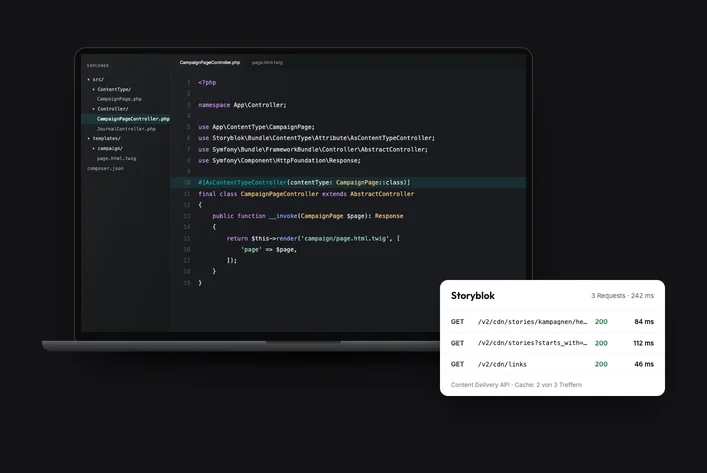
Code-Editor mit einem Symfony-Controller und ein Profiler-Panel mit Storyblok-API-Requests

Storyblok with Symfony and PHP

Since March 2025, PHP has had official packages: a typed Content Delivery API client, a Management API client, a Tiptap extension for rich text and a Symfony bundle. The bundle configures the client automatically, hooks into the Symfony Profiler and maps bloks to your own classes and controllers via attributes. Since 2026, it can also serve Storyblok assets through your own domain and cache them locally.

That makes Storyblok a content source for any Symfony application – including alongside Shopware, which is itself built on Symfony. The packages were developed by Storyblok together with SensioLabs, the publisher of Symfony and a creativestyle brand – so the expertise behind them is right here in-house.

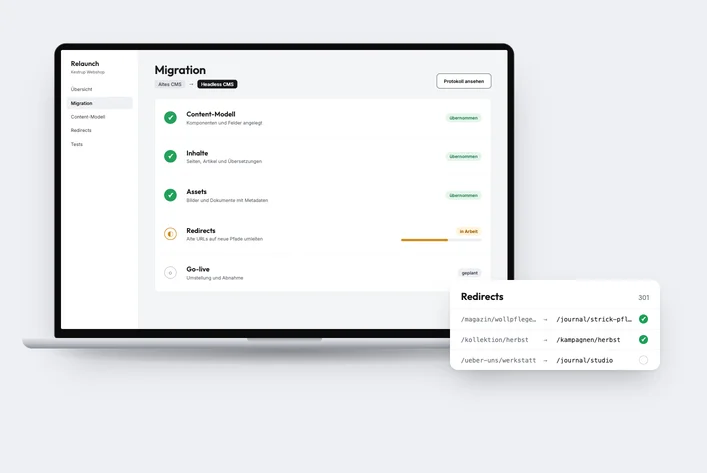
Migrationsübersicht mit erledigten Schritten für Content-Modell, Inhalte und Assets sowie Redirects in Arbeit

Migration: from WordPress, TYPO3 and other CMSs

Moving to Storyblok isn't a one-click data import. The new content model comes first: which components, which fields, which relationships? Only then does a migration script transfer content and assets via the Management API.

What doesn't come across automatically: templates, plugin logic and anything stored as HTML in body text in the old CMS. On top of that, you need a complete redirect map so rankings and backlinks survive the move. That's where the effort lies – and where an honest audit before kick-off pays off.

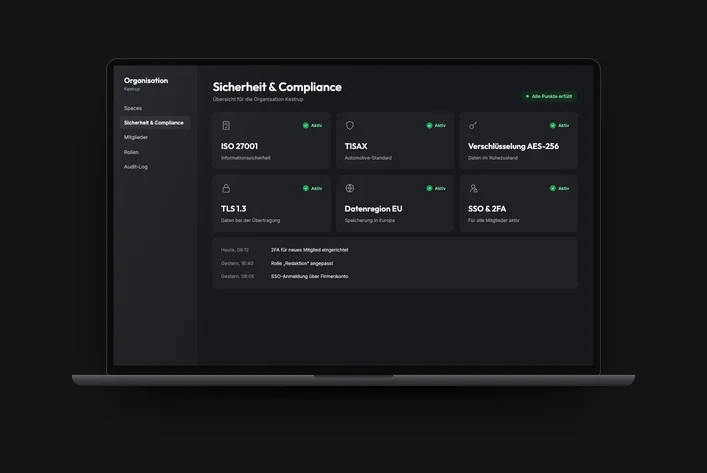
Dashboard mit Sicherheitsstatus für ISO 27001, TISAX, AES-256, TLS 1.3, EU-Datenregion sowie SSO und 2FA

Security, hosting and compliance

Storyblok runs on AWS and is ISO 27001 certified, as well as TISAX-assessed. Data is encrypted at rest with AES-256 and in transit via TLS 1.3. A data processing agreement is available for GDPR; with the EU data region, content stays in Germany. Depending on the plan, the uptime SLA goes up to 99.99%.

This covers the CMS, not your frontend: hosting, patch level, caching and monitoring of the website remain your responsibility – or your service provider's.

Who Storyblok is right for

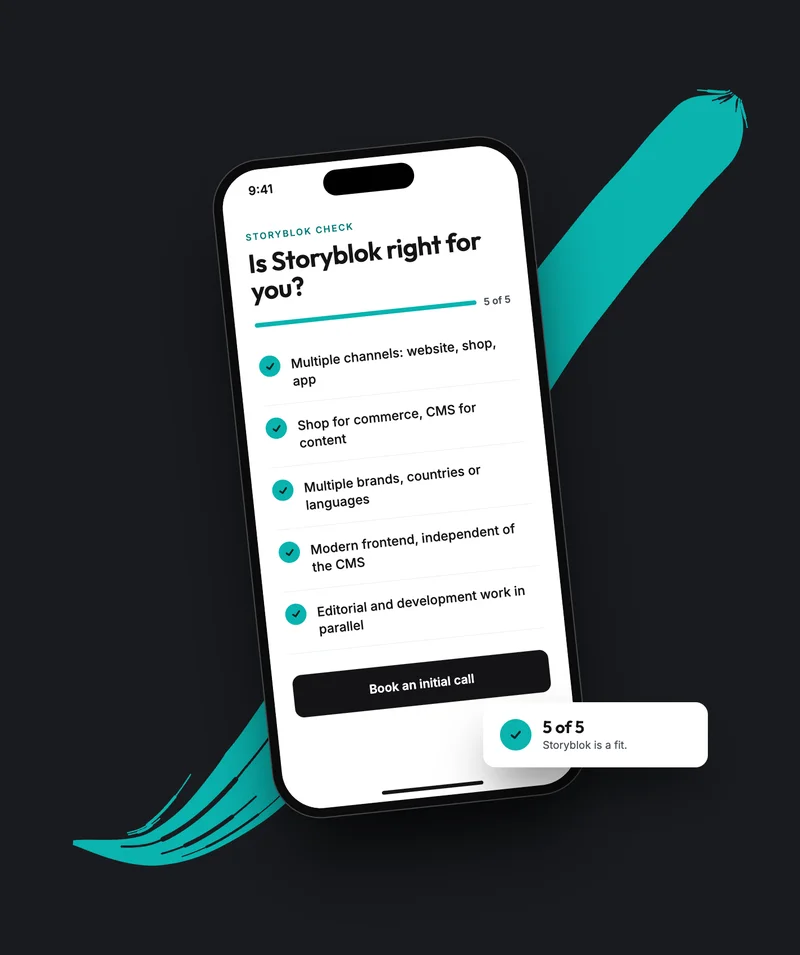
Storyblok is a good fit if at least one of these applies:

  • You publish content across several channels: website, shop, app, in-store displays.

  • Your shop system should do commerce, not content – and marketing needs more freedom than the shop CMS allows.

  • You run several brands, countries or languages with shared components.

  • Your frontend should run on modern technology, independent of the CMS release cycle.

  • Content and development teams need to work in parallel without blocking each other.

If you're planning a small website with no development team and no integrations, Storyblok is more than you need. We'll tell you that in the first call, too.

Passt Storyblok zu dir?" und fünf erfüllten Kriterien vor einem türkisen Pinselstrich

Our current Storyblok Projects

Explore how we use Storyblok to deliver flexible headless CMS solutions that combine editorial freedom with technical excellence and immersive brand experiences.

Staffbase mobile e-commerce interface showcasing AI guidelines for communicators and employee experience resources

Staffbase

Staffbase is a corporate communication platform that connects employees via an intranet portal or mobile app. It enables engagement, news delivery, and knowledge sharing for distributed organizations.

  • Fragmented, insecure WordPress landscape across multiple instances

  • Poor scalability and performance for rapid international growth

  • Inefficient workflows due to lack of uniform component structures

SensioLabs mobile interface showcasing architectural workshops and Symfony project services

SensioLabs

As the creator of the PHP Framework Symfony, SensioLabs provides expert consulting, architecture design, migration, and support for companies leveraging Symfony and various open-source technologies.

  • Relaunching international platform on modern Symfony/Headless CMS architecture

  • Implementing fully automated CI/CD pipelines for builds and deployments

  • Maintaining performance and code quality across complex system integrations

FAQ

traditional CMS manages content and renders the page itself. Storyblok only manages content; a separate frontend handles presentation. That gives you freedom in technology and channels, but it requires development work.

Benedikt, Director Partnership and Growth

Would You Like to Talk About Your Project?

With our creative approach, we support our clients' success. Feel free to contact us!

Benedikt Merl

Director Partnerships & Growth