
pimcore logo

Pimcore: the open-core platform for product data, assets and content

Pimcore is a data platform by Pimcore GmbH from Salzburg, Austria, combining PIM, MDM, DAM and DXP in one system. It is the central source of product data and media that feeds your shop, website, marketplaces and print. This page explains how Pimcore is built, which editions and licences exist, and who the platform pays off for.

What Pimcore is – and what it isn't

Pimcore is a PIM and MDM system with built-in DAM: you model products, variants, suppliers or stores as your own data objects, manage images, videos and documents in the same system, and deliver everything to your channels via API. On top come a CMS for websites and an e-commerce framework. Technically, Pimcore is built on PHP and Symfony.

What Pimcore isn't: a PIM you switch on and fill in. The data model is designed for your range, imports from ERP and supplier data need defining, and workflows and permissions need setting up. That turns the rollout into a data project. That's what you work with a Pimcore agency for – not for the installation.

The technical foundation

Pimcore is a PHP application built on Symfony, with MySQL or MariaDB as the database and OpenSearch or Elasticsearch for search and listings. Since 2026.1, the platform runs on PHP 8.4 or 8.5. Three points matter for architecture decisions.

You define data objects and their fields in the interface: attributes, relations, inheritance across variants, localised fields and a classification store for attribute sets per product group. Pimcore generates PHP classes from the definition, so developers keep working with typed code.

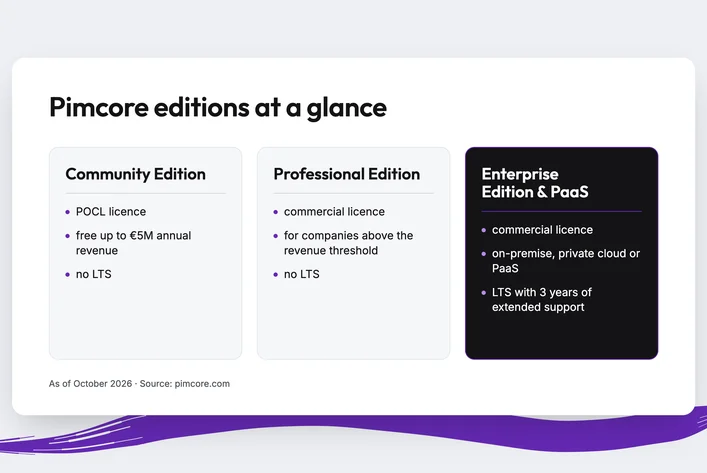
Overview of the Pimcore Community, Professional and Enterprise editions with licence, terms of use and LTS support

Editions, licence and release cycle

With version 2025.1, Pimcore moved the Community Edition from GPLv3 to the Pimcore Open Core License (POCL). Which edition you need depends on company size, operating model and support requirements.

Features that make the difference in projects

Product data & variants

Inheritance from parent to variant level, localised fields and attribute sets per category. Maintenance effort drops because shared data exists only once.

Digital asset management

Images, videos and documents with versioning, metadata and previews for more than 200 file formats. Thumbnails are generated automatically per channel.

Workflows & permissions

Approval processes from creation to publication, with roles and permissions down to field and language level.

Datahub & interfaces

GraphQL API for shop, app and marketplaces, plus configurable imports and exports for ERP and supplier data.

Data quality

Mandatory fields, validations and completeness checks per channel show which products are ready to publish.

CMS & e-commerce framework

Websites with inline editing, multilingual and multi-site support straight from the product data, plus catalogue, pricing and checkout for custom commerce solutions.

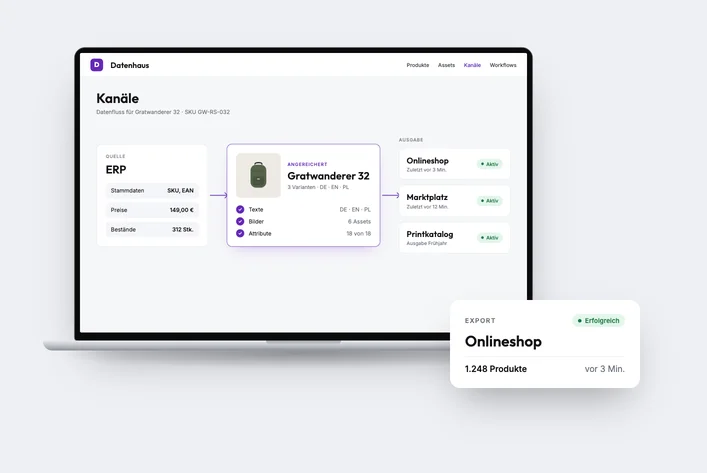
Data flow from the ERP through Pimcore to online shop, marketplace and print catalogue

Pimcore in the commerce stack

In e-commerce, Pimcore usually sits between the ERP and your channels. The ERP supplies master data, prices and stock; Pimcore enriches it with copy, attributes, images and translations and delivers it to Shopware, Magento, commercetools, marketplaces and print.

That keeps the shop lean: it sells instead of managing product data. The effort moves to where it belongs: into the data model and the interfaces. See how we connect Pimcore to shops in our projects further down.

Your Certified Pimcore Team

Karol, E-Commerce Consultant

Certifications:

AWS Certified Cloud Practitioner

Adobe Commerce Business Practitioner

Professional Scrum Product Owner

Professional Scrum Master

Certified Composable Commerce Functional Architect 2025

Shopware 6 Certified Solution Architect

Shopware 6 Certified PaaS Specialist

Karol
E-Commerce Consultant
Benedikt, Director Partnerships & Growth

Certifications:

Pimcore Consultant

Shopify Selling Fundamentals

Benedikt
Director Partnerships & Growth
Mateusz, Project Manager

Certifications:

Pimcore Product Expert

Pimcore Consultant

Contentful Certified Contennt Manager

Adobe Commerce Business Practitioner

Professional Scrum™ with Kanban

Professional Scrum Product Owner™

Professional Scrum Master™

Azure fundamentals

PRINCE2 Agile Foundation

PRINCE2® 6th edition Foundation

M_O_R® Foundation Certification in Risk Management

ITIL Foundation Certificate in IT Service Management

AgileBA® Foundation

AgilePM® Foundation

Mateusz
Project Management Services
Adam, Back-end Developer

Certifications:

Developer Junior

Pimcore

Developer Senior

Pimcore

Adobe Commerce Architect

Adobe Commerce Developer Professional

Adobe Commerce Developer with Cloud Add-on Expert

Adam
Backend Development Services
Jakub, Back-end Developer

Certifications:

AWS Certified DevOps Engineer - Professional

AWS Certified Developer - Associate

AWS Certified Cloud Practitioner

AWS Certified SysOps Administrator

AWS Certified Data Engineer - Associate

AWS Certified Solutions Architect - Associate

Shopware 6 Certified Frontend Developer

Shopware 6 Certified Advanced Template

Shopware 6 Certified App Developer

Shopware 6 Certified Solution Architect

Shopware 6 Certified PaaS Specialist

Shopware 6 Certified Advanced Developer

Shopware 6 Certified Backend Developer

Certified Developer Advanced

AWS Certified DevOps Engineer

Jakub
Technical Authority / Backend Development Services
Mariusz, Back-end Developer

Certifications:

Symfony 5 Certified Developer

Twig Designer

Mariusz
Backend Development Services

Our certificates

certified-pimcore-consultant-badge
certified-pimcore-enterprise-developer-badge
certified-pimcore-consultant-badge
certified-pimcore-enterprise-developer-badge
certified-pimcore-consultant-badge
certified-pimcore-enterprise-developer-badge
certified-pimcore-consultant-badge
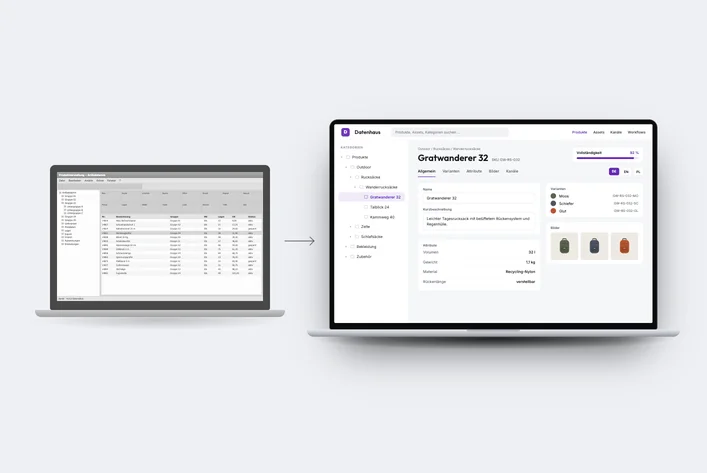
Before-and-after comparison of an old admin interface and the modern Pimcore Studio interface

Migration and upgrades: from Pimcore 11, spreadsheets or another PIM

The biggest upgrade topic right now is Pimcore Studio. Since 2026.1, the old ExtJS interface is gone, and custom admin extensions need rebuilding for Studio. Version 2025.4 is the last to run both interfaces side by side, which makes it a good intermediate step.

When moving from spreadsheets or another PIM, the data model comes first: which classes, attributes and inheritance does your range need? Only then do importers transfer the data. Most of the effort comes from messy legacy data, and that's exactly where an honest audit before kick-off pays off.

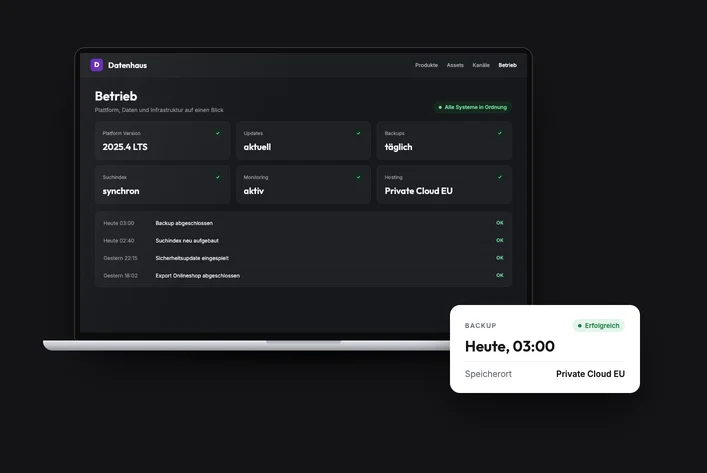
Dashboard showing the operations status of a Pimcore platform: version, updates, backups, search index and monitoring

Security, hosting and operations

Pimcore runs self-hosted, in a private cloud or as PaaS. When self-hosted, product data and assets stay on your infrastructure – an important point for GDPR-sensitive projects and data sovereignty.

Factor in the support window: without an Enterprise licence, support for a version ends with the next release, so regular updates are part of operations. Patch level, backups, search index and monitoring are down to you or your service provider.

Who Pimcore is right for

Pimcore is a good fit if at least one of these applies:

  • You manage product data in spreadsheets or several systems at once.

  • Your range has many variants, attributes or languages.

  • You supply multiple channels: shop, marketplaces, retailers, print.

  • Product data and assets should come together in one system.

  • You need a custom data model rather than a rigid off-the-shelf PIM.

If you manage a few hundred products in one shop, the shop system itself is often enough. We'll tell you that in the first call, too.


Smartphone showing a “Is Pimcore right for you?” checklist with five criteria met, in front of a purple brushstroke

Our Customers Rely on Pimcore

Learn how Pimcore serves as the foundation for flexible and scalable digital experiences, ensuring product data is managed and showcased with precision.

NKD

As one of Europe's largest textile discounters with 2,000+ stores, NKD embodies omnichannel commerce. Since their Adobe Commerce relaunch, we have been their reliable partner.

  • Complex system landscape with around 2,000 connected stores

  • Comprehensive click & collect strategy

  • Product and store management in Pimcore as a central platform

Shop Usability Award Nominated Badge

Praxisdienst

Praxisdienst is a leading German online supplier of practice supplies and medical devices, serving doctors, therapists and clinics. We migrated its established OXID shop to Shopware 6 while it kept running, connected it to ERP, PIM and Praxisdienst’s own systems, and implemented the B2B logic for international trade. A dedicated B2C shop followed shortly after.

  • Migrating an established OXID shop to Shopware 6 without stopping sales

  • Numerous custom features that build on each other and had to be moved in a fixed order

  • Complete transfer of customer history, orders, shopping lists and content

  • ERP integration with country-specific tax logic and VAT ID validation for international B2B

Frequently asked questions about Pimcore

Pimcore is a data platform that combines PIM, MDM, DAM and DXP. Companies use it to manage product data and media centrally and deliver them via API to shop, website, marketplaces and print.

Benedikt, Director Partnership and Growth

Would You Like to Talk About Your Pimcore Project?

Are you planning a new setup, a relaunch, or the next growth phase of your data workflows? Let's take a focused look at your requirements together and see how we can best support you.

Benedikt Merl

Director Partnerships & Growth