SCD 2026 Morning Recap: From Assistant to Operator: AI Takes Over Operational Tasks in Commerce

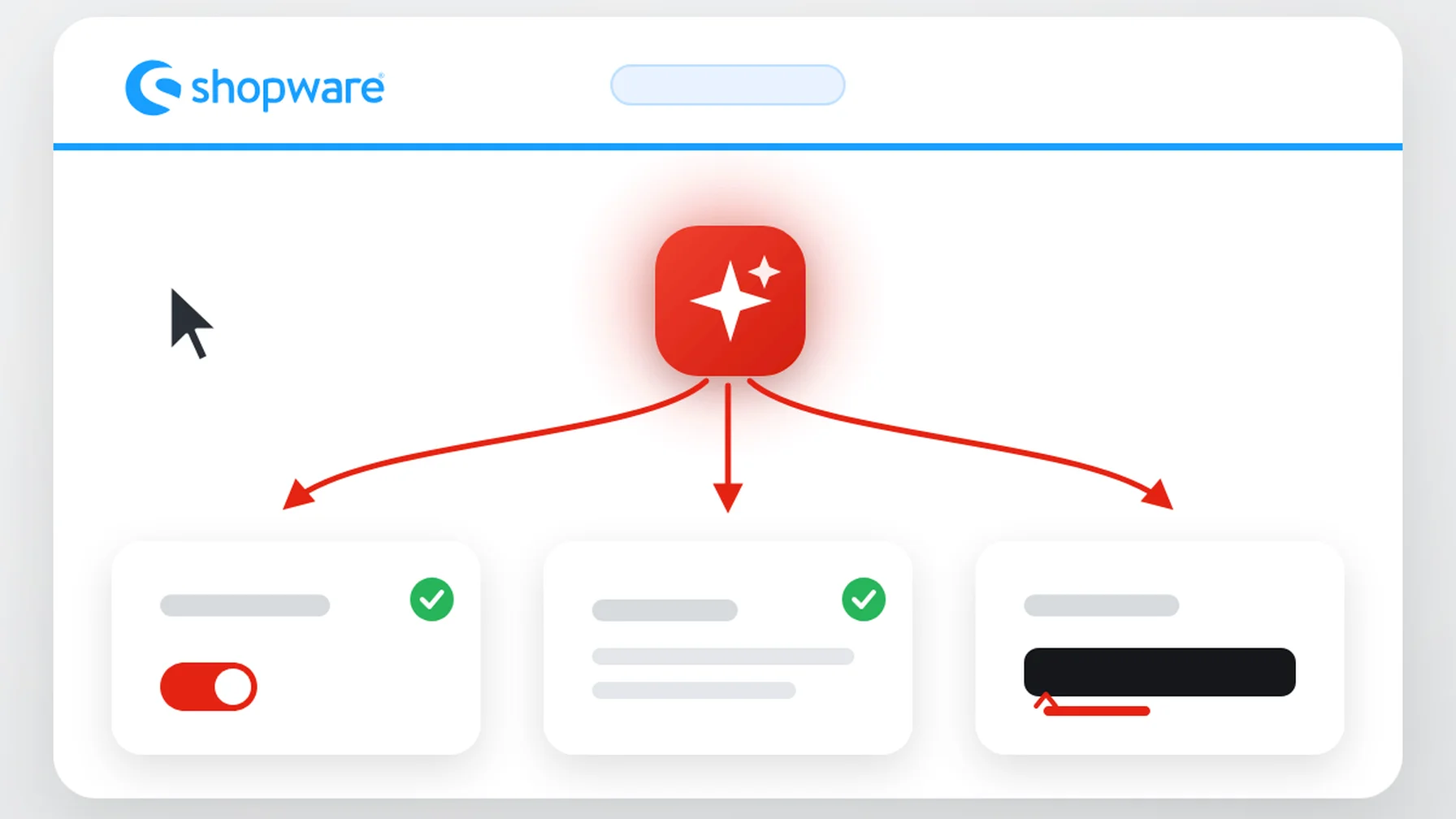
This year's Shopware Community Day made it clear right from the morning session which topic will shape the commerce industry in the coming years: Artificial Intelligence is evolving from a helpful assistant into an active component of operational business processes. While the discussions of recent years focused primarily on chatbots, content creation, and initial AI use cases, Shopware has now showcased the next evolutionary stage. The question is no longer whether companies use AI, but how deeply it can be integrated into existing processes. Together with the announcements regarding Shopware PaaS, a clear trend emerged: Less operational complexity, more focus on value creation.
Less Hype, More Practice
One of the most exciting observations of the morning was that Shopware did not present AI as a spectacular vision of the future. Instead, the focus was on concrete use cases and practical utility for merchants and commerce teams.
While many providers are currently trying to add as many AI functions as possible to their roadmaps, Shopware is increasingly focusing on the question of how companies can work more productively with AI.
This is less about individual features and more about processes.
How can marketing teams create campaigns faster?
How can product data be maintained more efficiently?
How can shop managers reduce administrative tasks?
And how do teams gain time for the topics that actually generate growth?
This is precisely where the next stage of development for Shopware Intelligence comes in.
AI Becomes Part of the Workflow
Probably the most important insight from the sessions surrounding Shopware Intelligence+ and Copilot was that AI is to be integrated much more deeply into operational processes in the future.
Until now, most AI applications have operated on a simple principle:
A user submits a request.
The AI delivers an answer.
Shopware is taking this approach further.
In the future, AI should not only assist but also be able to take over concrete tasks. This includes, for example, creating complex promotion rules, assisting with product maintenance, preparing campaigns, or handling administrative activities in the Shopware backend.
The decisive difference:
The AI no longer just provides suggestions; it becomes part of the actual workflow.
Of course, humans remain responsible. Decisions are not entirely automated. Nevertheless, a new division of labor is emerging between human and machine.
Why This Is Relevant for Merchants
Many commerce teams today do not struggle with a lack of ideas. They struggle with a lack of time:
Product ranges are growing.
Channels are becoming more numerous.
Markets are becoming more international.
At the same time, customer expectations are continuously rising.
Commerce teams today must create more content, manage more products, control more campaigns, and analyze more data than ever before.
This is precisely why operational efficiency is becoming a critical competitive factor.
When employees have to spend less time on repetitive tasks, free space is created for topics that actually influence revenue and growth:
Customer Experience
Conversion Optimization
Internationalization
New business models
Product range development
Customer retention
The most exciting insight of the morning was therefore not an individual AI function, but the fundamental direction.
AI is evolving from a tool into a productivity engine.
PaaS Becomes a Strategic Foundation
In addition to AI, infrastructure played a central role.
Shopware is consistently driving its Platform-as-a-Service strategy forward and making it clear that modern commerce projects should rely more heavily on standardized operating models in the future.
At first glance, this looks significantly less spectacular than artificial intelligence.
For many companies, however, the impact could be just as significant.
Because the reality of many commerce projects today looks like this:
A substantial portion of resources flows into hosting, deployments, monitoring, scaling, updates, and technical operational tasks.
All of these topics are necessary.
However, they do not create any direct customer value.
With PaaS, Shopware is therefore pursuing the goal of reducing technical complexity and relieving companies of infrastructural tasks.
Less DevOps, More Commerce
The idea behind it is simple:
Teams should spend less time operating the platform and be able to invest more time in the further development of their business.
This approach brings several advantages for merchants.
On the one hand, technical risks are reduced. On the other hand, platforms can be scaled more easily and developed faster. Above all, however, more room is created for the actual business challenges.
In the future, the question will be less:
"How do we operate our platform?"
Instead, it will be:
"How do we create better customer experiences?"
From our perspective, this is an important development.
Because the differentiation of modern commerce companies today arises through processes, services, and customer experience.
What Connects Both Topics
At first glance, AI and PaaS seem like two completely different topics.
In fact, both pursue the exact same idea:
Reduce complexity.
AI reduces operational work.
PaaS reduces technical work.
Both provide companies with more time for the things that truly create value.
This is precisely why the two topics complement each other so well.
Because AI unfolds its greatest utility not in isolated experiments, but within stable, scalable platforms.
The Bigger Development Behind the Announcements
When taking a step back, an overarching trend becomes visible.
Shopware is increasingly evolving from a classic commerce platform into a platform for commerce processes.
The central focus is on how companies can work more efficiently.
This is evident in:
AI-driven workflows
PaaS offerings
Automation
Integrations
Payments
Ultimately, all of these topics pursue the same goal:
Less operational friction. More focus on growth.
Our Assessment
The real story of the morning is not AI. The real story is productivity.
The companies that will be successful in the coming years are not necessarily those with the most AI tools. It is those that manage to meaningfully integrate AI into existing processes. At the same time, the PaaS strategy shows that modern commerce platforms are increasingly becoming a service. Infrastructure is progressively moving into the background.
Conclusion
The morning of the Shopware Community Day clearly demonstrated where the industry is heading.
AI is turning from an assistant into an operator. PaaS reduces technical complexity. Commerce teams gain more time for strategic tasks.
The most exciting insight is therefore that AI is increasingly becoming part of daily work. And that is exactly where its actual value will be created.