E-Commerce vs. Agentic Commerce: When the Shopping Cart Starts to Think

For decades, e-commerce has been a game of visual optimization: better usability, faster load times, and emotive imagery. But as AI agents begin to shop on behalf of humans, the rules are changing. Welcome to the era of Agentic Commerce.
The Paradigm Shift: From "Search & Click" to "Goal & Result"
Traditional e-commerce assumes a linear, human-driven journey: a user feels a need, searches for a product, compares options, and navigates a checkout. This is Active Navigation.
Agentic Commerce turns this model on its head. Instead of a user browsing a shop, an event-driven model takes over.
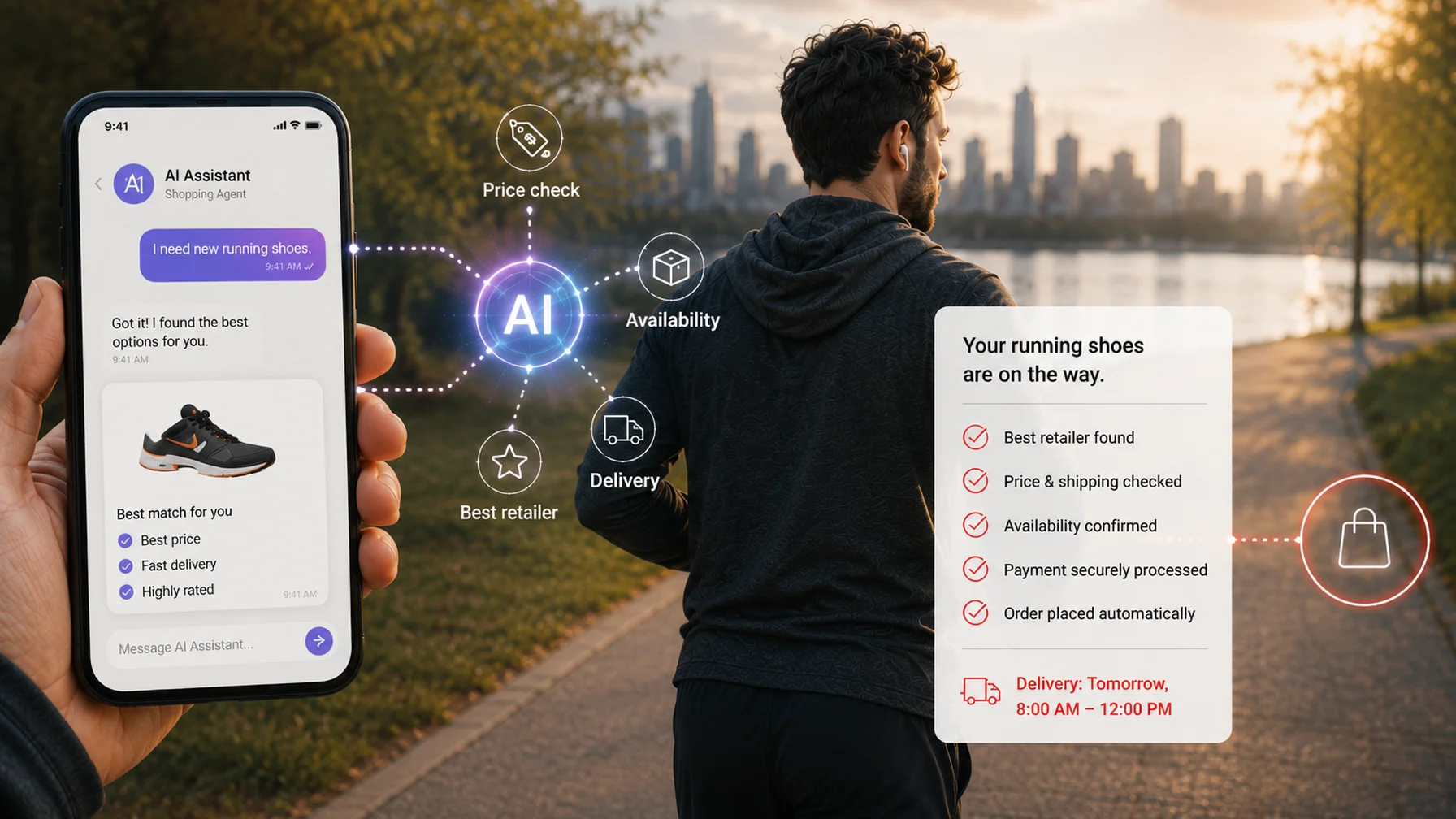
The Intent: "Find me the same running shoes as last time, but cheaper and delivered by tomorrow."
The Execution: An AI agent analyzes preferences, past purchases, and schedules. It scans the market, evaluates real-time logistics, and completes the purchase.
The actual buying process becomes invisible. For the user, the "Customer Journey" disappears—it is replaced by a Result.
The Evolution of Interaction: Why the Interface is Losing its Crown
The shift to Agentic Commerce isn't just a technical upgrade; it’s a fundamental change in how commerce functions across five core areas:
The Role of the User In traditional e-commerce, the user is Active (browsing and filtering). In Agentic Commerce, the user is Delegating (formulating goals and intent).
The Primary Interface Traditional shops are Visual (websites and pixels). Agentic Commerce is Systemic(APIs and data streams).
Decision Logic Decisions move from Emotional (branding and "vibe") to Rational (data, rules, and availability).
Visibility Strategy We are moving beyond SEO (ranking in search) toward EEO (Execution Engine Optimization—being "executable" by AI engines).
The Process The journey shifts from Linear (Cart to Checkout) to Event-Based (Need to Auto-Purchase).
The Technical Reality: From Frontend to Infrastructure
In the classic era, the Frontend was king. In Agentic Commerce, the Infrastructure takes the throne.
APIs are the New Storefront AI agents don’t look at hero images; they talk to systems. If your product data isn't structured or your prices aren't machine-readable, you are effectively invisible.
Headless & Composable is Mandatory You need a system that can expose its core functions (search, cart, payment) to external AI agents without requiring a browser.
Automated Checkout If an agent can’t authorize a secure, token-based payment via an API, it will move to a competitor who can. Your "agent-readiness" is defined by your checkout’s programmability.
Practical Implications: Data is the New Design
At creativestyle, we are already seeing the first cracks in the old model. Many companies invest heavily in high-end UX while neglecting their underlying data structure.
In a traditional setup, a human might forgive a missing product attribute. An AI agent cannot. If the data is inconsistent, the agent cannot interpret the product's relevance—and it will choose a supplier with a cleaner data feed every time.
The Strategic Shift:
SEO is now EEO: It’s no longer enough to be found; your system must be "ready to be used" by a machine.
Consistency is Conversion: Reliability and data accuracy are the new "emotional triggers."
How to Prepare: The Agentic Commerce Roadmap
Build a Clean Data Foundation: Structured, semantic, and consistent product data is the only language AI agents speak.
Treat APIs as a Product: Your APIs are your most important sales channel for the next generation of buyers.
Embrace Composable Architecture: Move away from monolithic systems to stay flexible enough for an automated world.
Master Machine-Readable Pricing: Ensure your pricing and availability are accessible in real-time, without human intervention.
Rethink CX: Acknowledge that a significant portion of your "Customer Experience" will now happen between systems, not on a screen.

Conclusion: The Future in AI
Agentic Commerce isn't just an evolution; it’s a paradigm shift. The focus is moving from interfaces to infrastructure and from design to data.
The classic online shop isn't going away, but its role is changing. It is evolving from a visual sales channel into a service layer for intelligent systems. The defining question for your business is no longer "How good does my shop look?" but "How well can my system transact with the world?"
Is your commerce stack "agent-ready"?
Don't wait for the pixels to fade. Let’s talk about building a scalable, future-proof architecture that puts your brand at the center of the automated economy.