
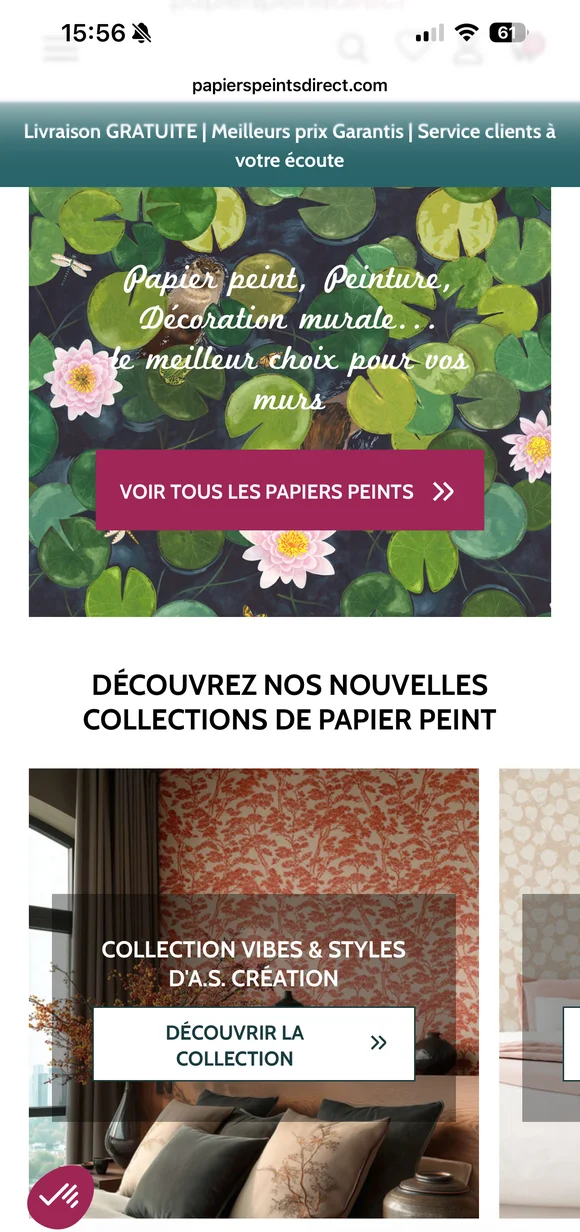
papierspeints
Since 2008, papierspeints has been France’s leading online destination for premium wallpaper and wall decor. We migrated the shop from a custom-built legacy system to Shopware 6, carried over every familiar feature and implemented automated SEO for categories and filters. The small team now manages the shop far more efficiently.
Replatforming a grown custom solution with a requirements document of more than 100 pages
Migrating around 80,000 products including customer data, orders and history
Automated meta titles, meta descriptions and category copy for many categories and filter combinations
A very small team (2–3 people) that previously had to maintain a lot by hand
Shopware 6 with every familiar feature, including sample orders, coordinated products and teasers that adapt to filters
Dynamic SEO content via CMS snippets instead of manual upkeep per category
Customer data, orders and history migrated in about four weeks
Technologies in this project
The stack behind France’s leading online store for premium wallpaper.
 An open-source e-commerce platform with a flexible CMS and an extensible plugin architecture. At papierspeints, Shopware 6 replaces a custom solution that had grown over the years, keeps every familiar feature and generates SEO content for categories and filters automatically.
Shopware agency
An open-source e-commerce platform with a flexible CMS and an extensible plugin architecture. At papierspeints, Shopware 6 replaces a custom solution that had grown over the years, keeps every familiar feature and generates SEO content for categories and filters automatically.
Shopware agency
 A payment provider that offers common payment methods through a single integration. In the shop, Mollie bundles all payments in one place, so the small team can manage them without extra effort.
 A feed management platform that prepares product catalogues for marketplaces, price comparison sites and shopping ads. For papierspeints, Lengow distributes the catalogue of around 80,000 products to further sales channels without manual upkeep.
With a custom solution, the devil is in the details

Since 2008, papierspeints has been France’s leading online destination for premium wallpaper. It moved from a custom-built legacy system to Shopware 6, with around 80,000 SKUs and a very small team. Project Manager Duy Pham on a requirements document of more than 100 pages, automated SEO for categories and filters, and what a Shopware agency has to deliver in a replatforming project.
papierspeints came from a custom solution. Why Shopware rather than Shopify or Magento?
The previous shop was built on a custom solution. Replatforming meant that every existing feature had to move with it, so there were a lot of individual requirements. In principle, that would have been possible on any platform. With this many custom features, though, Shopify would have hit its limits quickly, so it was ruled out early.
Magento stayed in the running longer, since custom solutions would have been just as feasible there. In the end, the more modern user experience tipped the balance: the papierspeints team is very small, and the Shopware admin won them over quickly.
On top of that came synergies: a partner agency brought Shopware experience from wallpaper e-commerce, and we adopted and ported several proven features from a partner shop. papierspeints benefited directly from that.
What would have spoken against Shopware?
The biggest concern was whether every requirement could be met. The old shop was a grown, very extensive custom solution. The shop owner worried that Shopware couldn’t cover his requirements at all, not exactly, or only with major restrictions. If the requirements hadn’t been feasible, that would clearly have spoken against Shopware.
We addressed this with in-depth workshops. The requirements document ran to more than 100 pages, and we went through it with the shop owner point by point, several times. As the Shopware agency, we had to confirm for every critical requirement that it could be delivered without major compromises. You rarely see that level of effort, but it is exactly what secured the decision.
How did the migration to Shopware work?
We had access to the existing shop, so we could look at the features from a user’s perspective and the development team could get familiar with them. On top of that came many conversations with the client, because the devil was in the details. When you have worked with a system for years, you take a lot for granted that isn’t standard in Shopware.
Access to the source code was a major lever. That isn’t a given. It let us clarify many detailed questions upfront and bring them into client meetings in a targeted way. Whatever didn’t come out of the conversations or the code, we looked up directly in the database.
After that, the work was very hands-on: regular meetings with the client, tightly scheduled iterations and feedback loops, and sprint reviews in which we demonstrated every implementation. Project and user documentation helped the client test and sign off. It was time-consuming, but that is exactly what made the project a success.
For the customer and order migration, we mapped the data from the old system: which fields Shopware needs to migrate orders, and which ones exist in the old shop. Because the client provided every access right away, this went much more smoothly than usual.
How long did the migration take?
Customer data, orders and history moved quickly: about two sprints, so four weeks, plus roughly two weeks of preparation. Because we could work with the original data, we were able to prepare the mapping well, and customer data, history, orders and products went through cleanly.
With any move to a new system, content is the bigger effort. Content migration can’t always be automated. Guide pages and other content pages largely had to be transferred by hand, and that took up to three months. That was less about technology than about time: the papierspeints team is small and had many other tasks in parallel.
What was the biggest technical challenge, and how did you solve it?
Automated SEO management for categories and filters. The shop has a very large number of categories and around 80,000 SKUs, and customers filter them by color, style and many other attributes. papierspeints didn’t want to maintain meta titles, meta descriptions and category descriptions by hand for every category. They had to be generated automatically and adapt to the filters applied.
An example: without a filter, the description says “All wallpapers” and the meta description reads something like “Discover our wallpaper collection”. When someone filters by blue, that becomes “Blue wallpapers” and “Buy blue wallpapers at [shop]”. This applies to many data points at once: category ID, category name, meta title, meta description, SEO keywords and the nesting of category levels.
We solved it with dynamic snippets in the CMS content. Admins can reuse this dynamic content across all CMS pages. It sounds simple, but with this many categories and filters it was a real challenge. The client tested and signed off on everything.
What did you extend in Shopware beyond the standard?
Because the old shop was a custom solution, papierspeints didn’t want to lose any of the features they were used to. An overview:
Dynamic content on the category page: banners, hero and carousel adapt to the filters. Filter by blue and you see a blue teaser with matching copy, filter by red and you see a red one. Shopware doesn’t offer this out of the box.
Dynamic SEO titles and meta descriptions based on the filter selection.
Optimized, more user-friendly product import and export.
Sample orders: many wallpapers have a sample that customers can add to the cart for free directly on the product page.
Coordinated products: products that go together, similar to a related-products carousel, with customized CMS components.
Customized USPs in the footer, product downloads and the display of product variants.
B2B: a customized shopping list widget, quote management and order history.
Much of this is possible in Shopware in principle, but not as specifically as papierspeints needed it. And these are only some of the customizations.
How big was the team, and how long did the project run?
The team was lean: one person each for backend, frontend and QA, plus project management. The kickoff with the client was on 9 July 2025, and go-live was planned for mid-January 2026. It was an ambitious schedule.
From a development standpoint, we would have made the date. We went live about eight weeks later, in March 2026. In a replatforming project, the client has many tasks of their own besides development: migrating content, adapting product data, taking over SEO and marketing topics. With a small team, the date shifts accordingly. In projects like this, that is the rule rather than the exception.
What do you take away from this project for future Shopware projects?
Above all, how much close collaboration with the client pays off. Through regular iterations and feedback loops, the new shop got step by step to exactly where papierspeints wanted it: with every familiar feature, just on a modern platform.
We’re taking that experience into our next projects. When a client comes from a custom solution, we invest even more time in the initial phase: we capture the details of the old solution, the desired result and the expected behavior together before implementation starts. Custom requirements that standard Shopware doesn’t cover are documented in detail right at the beginning. That makes implementation even more predictable and saves both sides rounds of alignment.

Planning a Shopware project?
Moving from a custom solution to Shopware without losing the features you rely on?
As a certified Shopware agency and Gold Partner, we support replatforming projects from requirements analysis through to ongoing operations.
Benedikt Merl
Director Partnerships & Growth