Shopware consulting: the edition decides your project budget

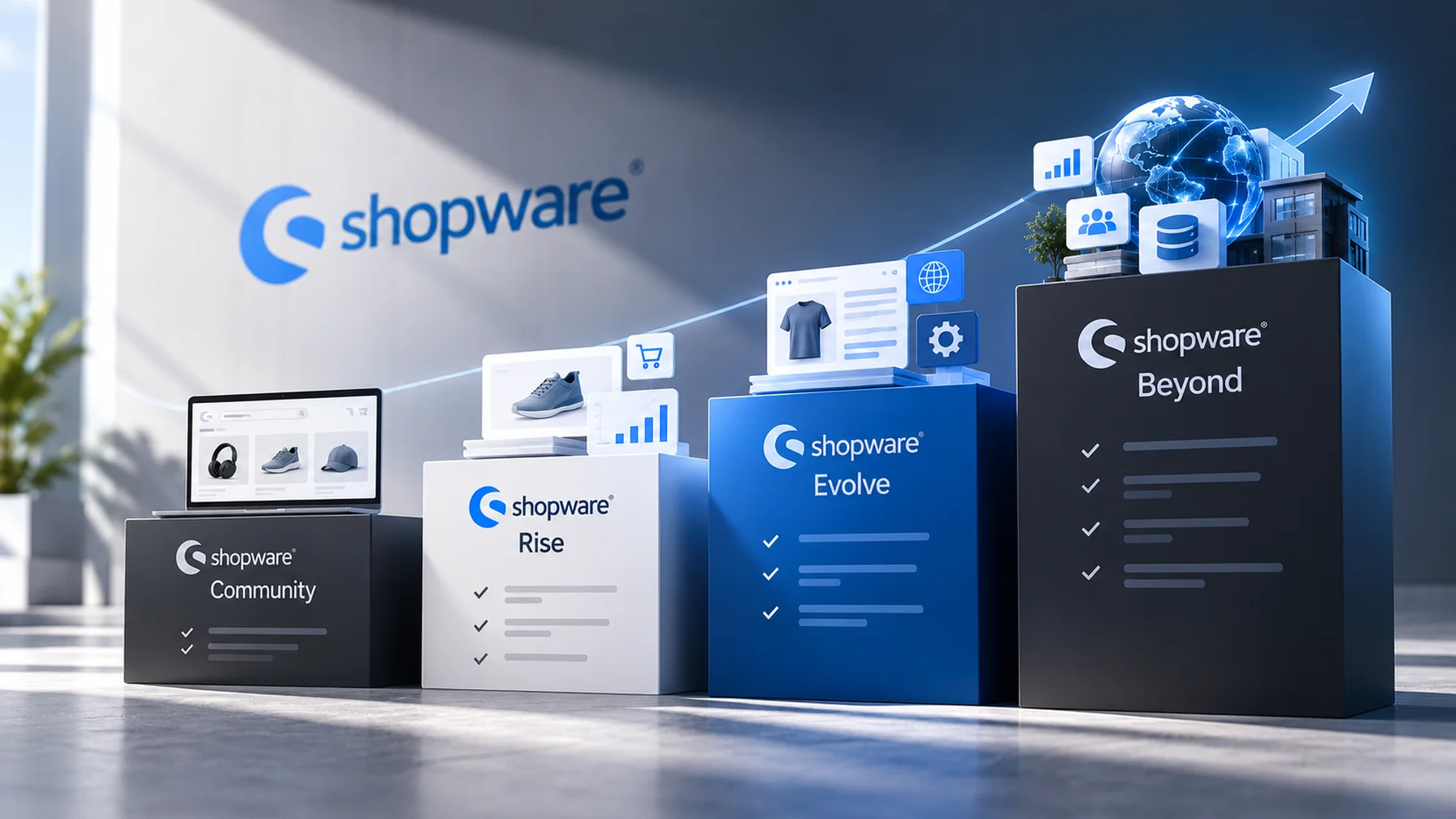 AI generated
Most Shopware projects get expensive before a single line of code is written. The reason is rarely the agency. It is an edition choice that matches the brochure instead of the business model. Book Evolve when Rise would do and you overpay by 21,600 euros a year. Book Rise when you need B2B workflows and you rebuild them later, at higher cost, as plugins.
That is why Shopware consulting starts before the project, with one question: which of the four tiers and which hosting model do you actually need? Since Shopware introduced its Fair Usage Policy in 2025 and priced its plans by revenue, this question also applies to shops that used to run the Community Edition for free.
This article walks you through the official feature allocation per edition and the decision rules we apply in projects.
What this article covers
What the four tiers Community, Rise, Evolve and Beyond actually contain, according to Shopware
Where the price jump from Rise to Evolve is justified and where it is not
SaaS, PaaS or self-hosted: which hosting model fits which team
A decision logic in five questions
Why the edition choice goes wrong so often
Shopware sells four tiers on one code base. Technically, a Community shop runs the same core as a Beyond system. The differences lie in unlocked features, support level and the revenue range the price covers. According to the Shopware pricing page, plan pricing is based on gross merchandise value (GMV) and further individual factors.
The problem in practice: merchants compare feature lists, the agency confirms the wish, and nobody checks whether the feature even occurs in the business model. The reverse happens too: shops start on the Community Edition, grow past the fair-usage threshold of one million euros GMV per year (Shopware, 2025) and then have to move to a plan under time pressure.
The four tiers as Shopware defines them
Community Edition is the MIT-licensed open-source core. Free, complete, but not available in the Shopware Cloud and without vendor support. Shopping Experiences, Rule Builder, Flow Builder, sales channels and the APIs are included. Shopware Intelligence and 3D capabilities are not.
Rise (from 600 euros per month) adds Shopware Intelligence, 3D capabilities and basic support with an eight-hour response time. Shopware positions Rise for growing B2C and D2C merchants.
Evolve (from 2,400 euros per month) is Shopware's bestseller. This is where the B2B Components come in: roles and permissions, quote management, quick ordering, shopping lists, Sales Agent, organisation units, customer-specific catalogues and budget management. Plus Advanced Search on Elasticsearch, Dynamic Access and webhook actions in Flow Builder. Four-hour response time, phone support.
Beyond no longer has a list price; Shopware says "custom". Exclusive to Beyond are customer-specific pricing, multi-inventory, subscriptions, Digital Sales Rooms and delayed actions in Flow Builder. Add 24/7 support with a one-hour response time, an account manager and written developer support.
One detail missing from most comparison articles: customer-specific pricing, meaning the one-to-one display of ERP net prices per customer, is listed as Beyond-only on the official pricing page. Evolve offers rule-based individual pricing, such as discounts per organisation unit. For many B2B merchants that is exactly the question that decides between 2,400 euros and a Beyond contract.
Hosting model: SaaS, PaaS or self-hosted
Shopware SaaS is the hosted variant with weekly automatic updates. You look after nothing, but you have limited influence over customisation and update timing. Shopware PaaS is also hosted by Shopware, but you keep control of updates and have full code access. Self-hosted runs on your own infrastructure or with a hosting partner.
Shopware states that SaaS costs the same as self-hosted; PaaS is priced individually. The rule of thumb from our projects: the more custom development and integrations, the stronger the case for PaaS or self-hosted. A standard shop with store plugins runs fine on SaaS. A B2B portal with real-time ERP integration and custom plugins needs deployment control.
What this means for your team
The edition also determines who does the daily work. With Evolve, sales gets the Sales Agent and can order on behalf of customers. With the Publisher from Evolve upwards, marketing works with drafts and approvals in Shopping Experiences. With Rise, much of that stays with the developer.
The catch with Rise: if you rebuild B2B logic as plugins, you get the same function without vendor maintenance. Every major release, and Shopware has 6.8 planned for 2027, becomes a test case for third-party plugins. These maintenance costs appear in no licence comparison.
From practice: three patterns we see regularly
First, the brochure purchase: Evolve "for B2B", although the shop serves consumers only. The B2B Components sit unused while the 1,800-euro monthly difference to Rise keeps running.
Second, the frugal start: Community Edition for a shop that crosses the million in year two. Moving to a plan is technically simple, but it usually lands mid-season and without a budget line.
Third, the Beyond surprise: a B2B merchant plans with Evolve, discovers during concept work that the ERP pricing is customer-specific, and ends up in a Beyond negotiation nobody had planned for.
Five questions that fix the edition
Do you sell to business customers with roles, approvals or budgets? Yes: at least Evolve.
Do you need net prices per customer from the ERP, not just discount rules? Yes: have the Beyond conversation, or keep pricing logic in the ERP and solve it via integration.
Is your GMV below one million euros and likely to stay there? Yes: the Community Edition is legitimate; budget for hosting and maintenance.
Do you have a team that can own deployments? No: SaaS or managed hosting, not self-hosted.
Which response time costs you most during an outage? The answer sets the support level, not the feature list.
Conclusion
Good Shopware consulting reduces the edition question to your business model: who buys from you, how prices are formed, who runs the system. The official feature allocation is unambiguous; the mistakes happen when it meets reality.
Strategically, the edition is a multi-year cost decision. Upgrades and downgrades are possible, but the architecture you build on one edition does not move with you.
With Shopware 6.8 in 2027 and the end of the legacy B2B Suite, the line shifts further towards the B2B Components. Anyone deciding today should plan against that roadmap.
If you are facing this decision, we check your business model against the editions before any quote is written. As a Shopware Gold Partner, we do this in a half-day workshop.
FAQ
Which Shopware edition do I need for B2B?
For B2B workflows such as roles, approvals, budgets and quotes you need at least Evolve, because that is where the B2B Components start. Customer-specific net prices are Beyond-only according to the Shopware pricing page.
Can I use the Community Edition commercially?
Yes. The Community Edition is MIT-licensed and free for commercial use. From one million euros GMV per year, Shopware's Fair Usage Policy applies and a plan has to be booked.
Can I start on Rise and move to Evolve later?
Yes, you can switch at any time. Do plan for migrating any B2B functions you rebuilt as plugins over to the B2B Components.
What is the difference between Shopware SaaS and PaaS?
SaaS is hosted by Shopware and updated automatically every week. PaaS is also hosted by Shopware, but you keep control of updates, deployments and your own code.
What does Shopware Beyond cost?
Shopware no longer lists a price for Beyond; it says "custom". The price is negotiated individually based on GMV and requirements.