EU warranty label: mandatory in every shop from 27 September 2026

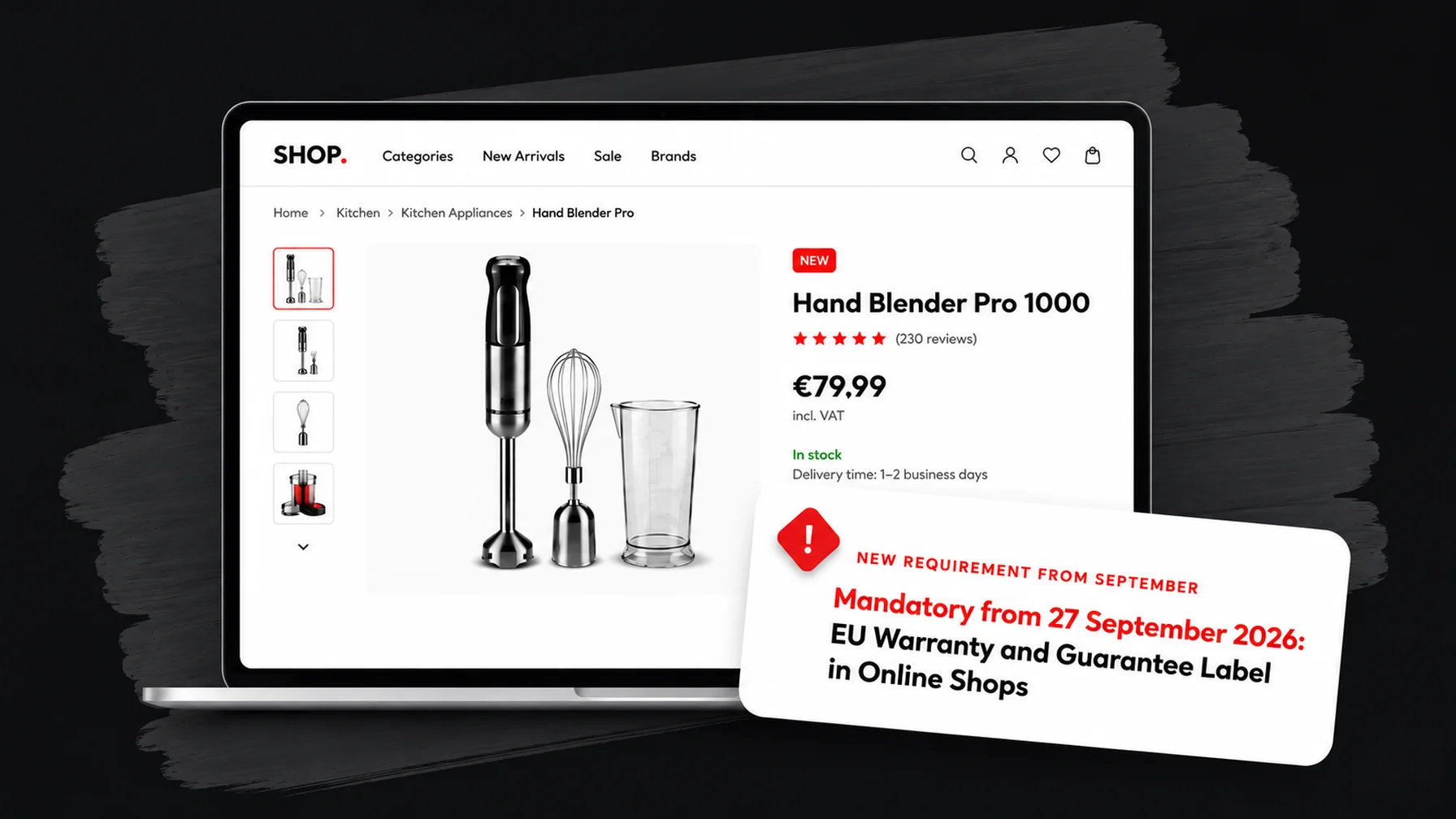
Statutory warranty or commercial guarantee? Customers mix them up. From 27 September 2026 every B2C shop must show the standardised EU warranty label. What it means for your shop and how to prepare.
Statutory warranty or commercial guarantee? Ask ten customers and nine will lump the two together. That's exactly what the EU wants to fix. From 27 September 2026, every B2C online shop has to show the same badge: the new warranty label, a standardised, EU-wide notice about the legal rights that come with every purchase. Nothing about it is optional, and you can't click it away.
At first glance it sounds like "just another icon in the shop". In reality it's mostly a technical job: product pages, product data and checkout all need attention. And if you run a large catalogue or sell through marketplaces, you're better off starting now than scrambling in September.
This article covers what the warranty label means for your shop and what to prepare technically. It's practical guidance, not legal advice.
What this is actually about
The warranty label is a standardised mandatory notice. It points your customers to their statutory warranty rights — including the minimum period of two years. The legal basis is EU Directive 2024/825 (EmpCo, "Empowering Consumers for the Green Transition"); the exact look is set by Implementing Regulation (EU) 2025/1960. It applies across the EU from 27 September 2026, transposed into each country's national law.
Why the effort? Because in many customers' heads, statutory warranty and guarantee are the same thing — and they're not. The statutory warranty is your customer's legal right if something is faulty. A guarantee is a voluntary promise on top, usually from the manufacturer. The label finally makes that difference visible.
Warranty label or guarantee label? The difference in brief
Quick heads-up, because it's easy to mix up: there are two different labels — and most shops only need the first.
The warranty label is the standard. It informs customers about the statutory warranty, the right they have with every purchase anyway. That's why it's mandatory for every B2C shop and belongs on every product.
The guarantee label is the exception. It only comes into play when someone voluntarily promises more than the law requires — whether the manufacturer or you as the seller — namely a free durability guarantee that covers the whole product and runs longer than two years.
Why "longer than two years"? Because the statutory warranty already covers two years. A guarantee of exactly 24 months adds nothing on top — so it needs no separate label. Only when the guarantee goes beyond that, say three or five years, is there real added value that has to be flagged.
An example: you sell an espresso machine with a three-year manufacturer guarantee? Then that product needs an extra guarantee label — with brand, model and duration. The same machine with just two years of guarantee? Only the standard warranty label, like every other product.
Where it has to appear — and where it doesn't
Here the EU is precise. The warranty label has to be fully visible, in colour and clearly noticeable — on the product page or in the checkout, in any case before the order is placed. A link in your terms and conditions? Not enough.
And don't get creative with the design: colours, proportions and content are fixed, and you may not adapt the label to your corporate design. The goal is a look that's identical across Europe. A collapsed, click-to-reveal version isn't an option for the warranty notice either.
With the guarantee label you get a bit more room: online, it may be shown nested — but it has to appear in full at the first click, rollover or tap. Because every guarantee is product-specific, it belongs right next to the product. As with other mandatory information, it's also advisable to make the details available to the customer again after purchase, for instance in the confirmation email.
Why this hits your frontend
Even though it's formally "just" an information duty, in practice compliance keeps moving deeper into product data. Legal texts alone no longer cut it.
Your shop now has to reliably serve the warranty label on all products and the guarantee label only where a qualifying guarantee is stored. That touches templates, data maintenance and the order process. With a small catalogue it's quickly done. With thousands of items, maintaining the per-product guarantee data becomes the real legwork.
Marketplaces like Amazon or eBay are especially tricky. There, you as the seller are responsible for your mandatory information — including correct display. Technical limits of the platform aren't an excuse that automatically lets you off the hook.
Four steps to keep it stress-free
Check whether you're affected. Do you sell to consumers (B2C)? Then you need the warranty label — including for used goods and even in a pure grocery shop.
Review your guarantees. Which products carry a voluntary durability guarantee of more than two years? Only those need an extra guarantee label.
Get templates and data model ready. Build the basis to serve the labels cleanly on the product page, in the cart and at checkout.
Plan for post-purchase delivery. As with other mandatory information, you should make the details available to the customer after the order too — for example in the confirmation email.
Bottom line
From 27 September 2026 the warranty label isn't a nice-to-have, it's mandatory for every B2C shop. Get the display or the language wrong and you risk warnings — with EU-wide harmonised rules, competitors are watching closely.
There's an opportunity in it, too: clearly presented warranty and guarantee information builds trust exactly where the buying decision happens — and answers questions before they turn into abandoned carts. Less grey area, more clarity.
The only real opponent is time. Start implementing in September and you're needlessly under pressure. You can begin today.
Talk to us
Want the warranty label built in cleanly and on time — on the product page, in checkout and in the confirmation email? We handle the technical integration and the product-level logic for the guarantee label. Get in touch and we'll look at your setup together.
FAQ
What is the EU warranty label?
The warranty label is a standardised, EU-wide mandatory notice. It informs consumers about their statutory warranty rights and the minimum period of two years. It is based on the EmpCo Directive (EU) 2024/825.
When does the warranty label become mandatory?
From 27 September 2026, for all traders selling to consumers (B2C). The rules apply across the EU and are transposed into national law.
What's the difference between the warranty label and the guarantee label?
The warranty label is mandatory for every B2C shop and covers all goods. You only need the guarantee label if a product has a voluntary, free durability guarantee of more than two years.
Can I adapt the warranty label to my shop design?
No. Colours, proportions and content are fixed by the EU. In an online shop the label has to appear in colour, fully visible and unchanged on the product page or in checkout — a link in the terms and conditions isn't enough.