AI Agents in B2B Purchasing: Why the Digitalization of Sales Is Now Becoming a Competitive Advantage

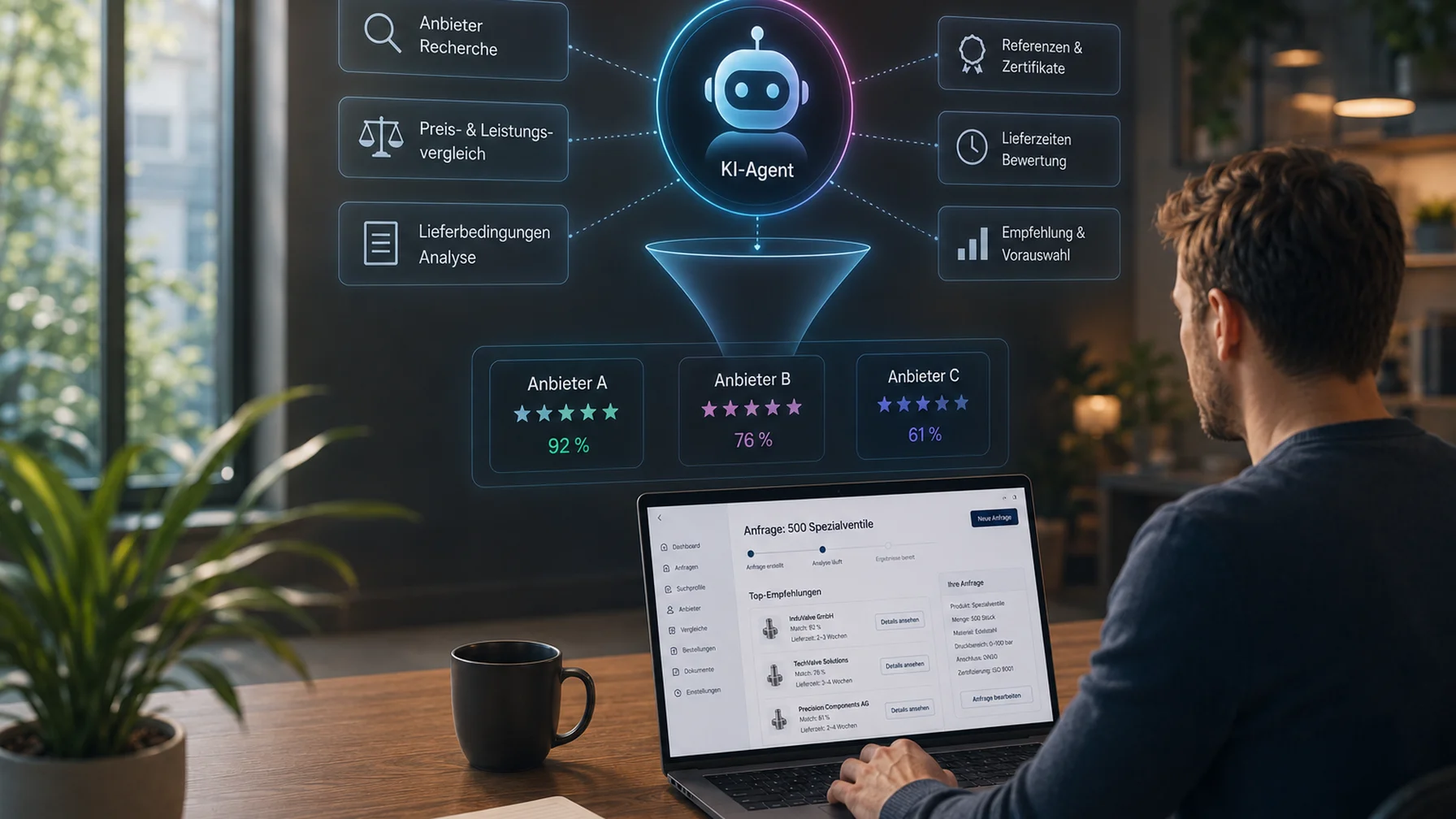
The new customer for B2B sales is no longer just the human buyer – it is also their AI agent. AI agents in B2B are increasingly taking over tasks that were previously performed manually by procurement professionals. They research suppliers, compare prices, analyze delivery terms, and create a pre-selection of potential partners. For B2B sales, this represents a fundamental shift: visibility is no longer created solely by and through people, but also by the AI systems that prepare purchasing decisions. Consequently, a core assumption in sales is changing: companies no longer compete exclusively for the attention of potential customers; they increasingly compete for the attention of the AI systems that support these customers during research and evaluation. The crucial question, therefore, is not whether AI agents will change B2B purchasing. The crucial question is: How must companies digitize their sales to remain visible in a world where AI systems make the initial selection?
What Are AI Agents?
AI agents are autonomous software systems that can independently plan, execute, and evaluate tasks. In B2B purchasing, they support companies by researching information, comparing suppliers, and preparing procurement decisions.
Unlike traditional search engines, they do not just provide information; they analyze it within the context of a specific task.
For example, an AI agent can:
Research providers
Compare product information
Analyze prices
Evaluate delivery terms
Check references
Create actionable recommendations
This creates a entirely new form of digital support in procurement and B2B purchasing.
How Agentic AI Is Changing the B2B Purchasing Process
From Search to Delegation
The traditional purchasing process was long characterized by manual research. Buyers visited websites, held talks with suppliers, compared offers, and evaluated different solutions.
With Agentic AI, this process is shifting. More and more research and analysis tasks are being delegated to intelligent systems. While humans remain the ultimate decision-makers, the preliminary work is increasingly being done by machines.
A concrete example: A buyer is looking for 500 specialized valves for a new production line. Instead of manually comparing 20 different websites for days, they feed their AI agent the exact technical requirements. The agent scans the web in real time. The problem: Companies that do not provide their data in a structured and open way are eliminated from consideration within seconds – even before a human has had a chance to look at it.
Suppliers Are Evaluated Before Sales Is Ever Contacted
One of the most critical changes for companies is that sales often only come into play after an AI agent has already analyzed and evaluated potential suppliers.
Prices, scope of services, delivery terms, references, and technical information may already be fully evaluated before the first meeting even takes place. This significantly shifts a major part of the purchasing decision forward.
AI Agents Are Accelerating the Digitalization of B2B Sales
Many companies are currently discussing artificial intelligence as a standalone topic. However, the real change begins much earlier.
AI agents can only function effectively if the relevant information is digitally available. Companies with modern sales platforms, customer portals, and structured product data create significantly better conditions for this.
Those who still rely heavily on manual processes, PDF catalogs, or individual information requests risk becoming invisible in automated research processes. The digitalization of sales is therefore no longer just a question of efficiency – it has become a question of visibility.
Why Self-Service Is Becoming Crucial in B2B
For a long time, self-service was primarily considered a tool for improving the customer experience. AI agents give this topic a completely new meaning: machines prefer information that is instantly available.
Companies with digital customer portals, self-service offerings, and transparent product information create optimal conditions for automated purchasing processes. This includes, for example:
Digital product catalogs
Customer portals
Individual price lists
Real-time availability information
Technical documentation
Product configurators
Order histories
What primarily served to improve the user experience in the past will directly influence visibility among AI systems in the future.
Modern Commerce Platforms: The Foundation of Digital Sales Strategies
In practice, AI readiness is rarely just an AI issue – it is a platform issue. It comes down to your digital strategy and how digital your sales processes truly are. AI systems can only access information that is structured, up-to-date, and digitally accessible.
This is where modern B2B commerce platforms come into play. For a long time, digital commerce was considered a purely B2C topic. Today, it is moving into the spotlight for efficient and modern B2B companies. A digital sales structure – meaning a B2B commerce platform – creates the foundation for:
Consistent product data
Centralized information delivery
Seamless self-service processes
Advanced customer portals
Personalized offers
Seamless system integrations
Companies that modernize their commerce platforms are doing far more than investing in a better customer experience. Simultaneously, they are creating the core prerequisites for being seen and understood by search engines, AI agents, and digital assistants.
What Do AI Agents Analyze When Evaluating Providers?
When AI agents take over pre-qualification, they need data they can easily evaluate and compare. This includes, in particular:
Product specifications
Prices and pricing structures
Lead times and delivery schedules
Certifications and compliance data
Customer testimonials and case studies
Industry expertise
FAQs
Technical documentation
Integrations and interfaces
Service and support models
The more structured this information is provided, the easier it is for AI systems to analyze it. This creates a new competitive advantage for companies: it's no longer just the quality of the products that matters, but the quality of the data provided that becomes the ultimate success factor.
The Future of B2B Commerce: People Buy, AI Researches
People will continue to make the final purchasing decisions in the future, especially when it comes to complex or customized products. However, the path to getting there is fundamentally changing. AI agents are increasingly taking over the research, analysis, and pre-qualification of suppliers.
For companies, this means they must not only digitize their sales operations, but they must also structure their sales information in such a way that it can be read and utilized by customers, traditional search engines, and AI agents alike.
This is precisely where sales, commerce, customer experience, and platform strategy intersect. Those who invest early in modern commerce platforms, customer portals, and high-quality data will benefit from this development. Those who optimize exclusively for human users risk being left out of future buying journeys entirely.
Actionable Recommendations for Businesses
Align Sales and Commerce More Closely Digital sales channels are becoming a core, inseparable part of the B2B customer journey.
Expand Customer Portals and Self-Service Capabilities Both human customers and AI agents require direct, friction-free access to relevant information.
Treat Product Data Strategically Structured, clean data is becoming the ultimate foundation of digital visibility.
Think SEO and GEO Together Sichtbarkeit (Visibility) in the future will be decided across both traditional search engines and AI systems via Generative Engine Optimization (GEO).
Modernize Commerce Platforms Modern, flexible architectures create the necessary infrastructure for next-generation digital sales models.
Conclusion
AI agents in B2B purchasing are fundamentally transforming the buying journey. Supplier research, price comparisons, and initial assessments are becoming increasingly automated, shifting the exact point at which sales teams and prospects first interact.
For businesses, this is far more than just a passing AI trend; it is a powerful driver for the total digitalization of sales.
Modern commerce platforms, customer portals, and self-service offerings will do more than just improve the customer experience in the years to come. They will determine how visible companies are to the AI systems that shape purchasing decisions. The future of B2B commerce belongs to companies that are understood by humans and machines alike.
Building Digital Commerce
Because the digitalization of sales doesn't end with the customer experience. It increasingly determines how visible your company becomes to the systems that prepare the purchasing decisions of tomorrow.
How ready is your commerce platform for the next generation of digital purchasing processes?
FAQs
Frequently asked questions about how Agentic AI is transforming procurement and why your digital commerce platform is the key to remaining visible.
No. AI agents support and accelerate the purchasing process, but they do not replace strategic decision-making, relationship management, or complex negotiations.
By implementing modern commerce platforms, expanding customer portals, offering self-service capabilities, automating backend processes, and providing highly structured, openly accessible product information.
B2B commerce platforms act as the data repository that enables both human customers and AI systems to independently retrieve information, compare products, and prepare purchasing decisions 24/7.
They create data transparency, significantly improve the customer experience, and act as the necessary interface to support automated purchasing processes.