Siriderma
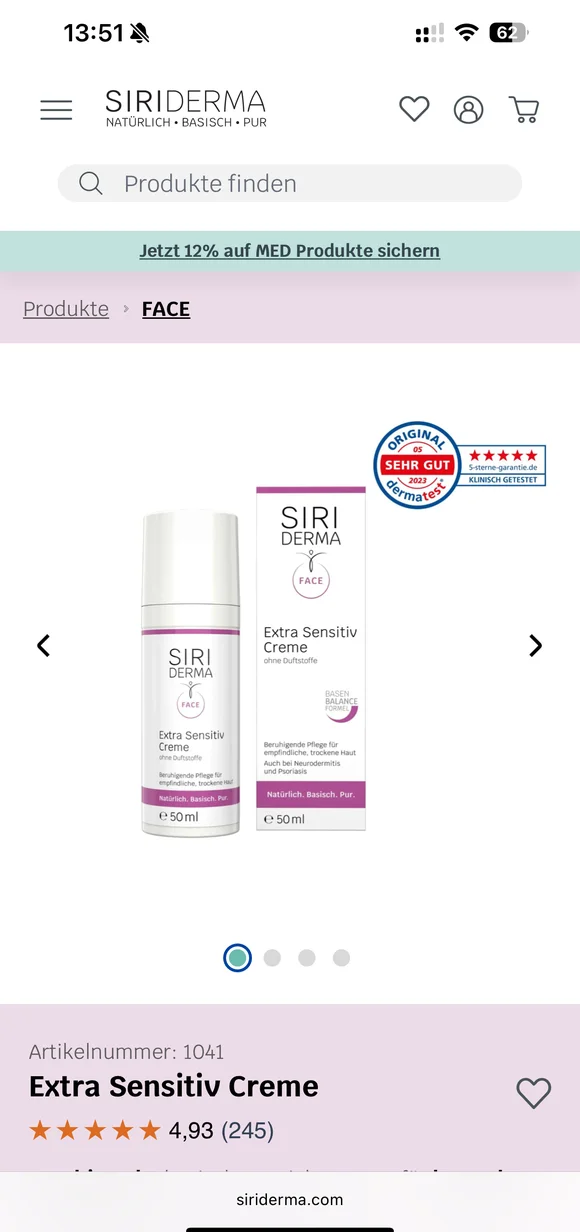
Siriderma is a German brand of alkaline skincare products focused on highly tolerant formulas free of fragrance and irritants. It provides solutions particularly for atopic dermatitis, psoriasis, and rosacea.
As a Shopware agency, we took over the Shopware 6 store from another agency in January 2024 and have developed it further in 28 releases since then.
Consultation-intensive products require comprehensive customer guidance
Provide detailed information on ingredients and application
Offer personalized recommendations based on skin type and medical needs
Support customers in selecting suitable products
Taking over the store from another agency without complete documentation
Digital product advisor and guide to help find suitable products for individual skin conditions
Proprietary loyalty program that fosters long-term customer retention
Over 70% returning customers
28 releases since 2024, updates to Shopware 6.6 and 6.7 without downtime
Store adapted to accessibility requirements (BFSG) after an audit
Search results page redesigned with a rebrush
Two more major projects with Siriderma already in the pipeline
Technologies in this project
The stack behind Siriderma's store for alkaline skincare.
-
Shopware
 The open-source commerce platform built on Symfony. At Siriderma, Shopware 6 powers the product finder, the product detail pages and the SIRI stars loyalty programme, whose points balance is synced with SAP.
Shopware agency
-
Mollie
 Payment provider in Siriderma's Shopware checkout, extended with PayPal and Apple Pay.
A store we didn't build – and have improved every month for three years

Siriderma sells alkaline skincare for people with atopic dermatitis, psoriasis and rosacea, which means products that need explaining. creativestyle took over the Shopware 6 store from another agency in January 2024 and has developed it further in 28 releases since then. Marianne Mader has managed the project since the takeover. In this interview she explains how a takeover without documentation works, why a points programme in SAP is the most critical integration and what accessibility means in practice.
Siriderma isn't a relaunch but a takeover. What does the first month look like?
With an inventory, not with features. In December 2023 we got access to the repository, custom plugins and administration and first worked out what was actually running. That sounds trivial, but it's the part many agencies skip. Then came access: read access for us, revocation for the predecessor, environments documented. Only then did we touch the first ticket.
The backlog contained around a dozen open bugs that hit customers every day: wrong shipping display for Austria, vouchers with incorrect discount calculation, order status “unconfirmed” despite payment. We worked through them in the first two releases. A store that's live doesn't forgive a learning phase.
What did you deliberately replace rather than repair?
Third-party plugins whose maintenance would have cost more than rebuilding. We replaced the previous agency's slider plugin with our own leaner solution after every Shopware update brought new display bugs. The rule: whatever the Shopware standard or the Store covers cleanly, we use; whatever only works with the old agency's special knowledge gets replaced.
Conversely, we kept a lot. We extended the Mollie integration with PayPal and Apple Pay instead of switching payment provider. A switch would have cost customers more than it helped.
The SIRI stars are a points programme with data in SAP. Why was this the most critical integration?
Because customers see it. Stars are credited per order and can be redeemed in the cart; the truth about the balance lives in Siriderma's SAP. Every discrepancy between the store and SAP creates a support request. At first, such discrepancies occurred regularly.
The second stage was performance: the star sync ran synchronously at login. When SAP responded slowly, the customer waited on the login page. In 2025 we decoupled the call: login goes through immediately, and the stars are loaded in the background. A small change with a big effect on perceived speed.
Siriderma sells products that need explaining. What's different from standard B2C?
The advice has to happen in the store. A product finder leads via skin type and symptoms to the right care; we completely rebuilt the product detail page in 2024, with ingredients, application and reviews where the purchase decision is made. Sample vouchers, which Siriderma uses a lot, are more prominent in the cart.
What we learned: for this target group, trust matters more than speed. That's why we analysed customer behaviour with Microsoft Clarity and reworked the checkout in 2026 based on real drop-off points, not best-practice lists.
28 releases in almost three years. What does a release month look like?
A fixed rhythm: code freeze, release tests on staging, deployment, after-release tests. In between, hotfixes when necessary; 13.5, 14.5 and 22.5 were such cases. The rhythm matters more than any single release. Siriderma knows when something goes live and can plan marketing around it.
We handled two major updates in the same cycle: Shopware 6.6 in spring 2024, 6.7 in March 2026. Both without downtime, because the plugin landscape had already been cleaned up by then. Since October 2026, automated end-to-end tests run alongside so that manual test time per release goes down.
Accessibility: what specifically had to happen for the BFSG (German Accessibility Act)?
An audit in spring 2025 followed by a list of adjustments: contrast, focus order, form labels, alt texts, keyboard operability in the checkout. Most of it is frontend craftsmanship, not architecture. The catch: it affects every template, including those nobody has touched for years. Since September 2026, statutory guarantee notices on the product page and order confirmation have been added.
What is still uncomfortable at Siriderma today?
The dependency on systems we don't operate. Payment problems at Mollie caused their own bundle of tickets in 2026, and for the SAP sync we depended on the client's team. And: a store you've taken over carries legacy issues that you only find at the next update. Three years later, the code is mostly our code, but only mostly.
Planning a Shopware project?
Want to hand over your Shopware store to a new agency? As a Shopware agency, we take over existing stores and develop them further.
Benedikt Merl
Director Partnerships & Growth