Shopware open source: the core is free, B2B isn't

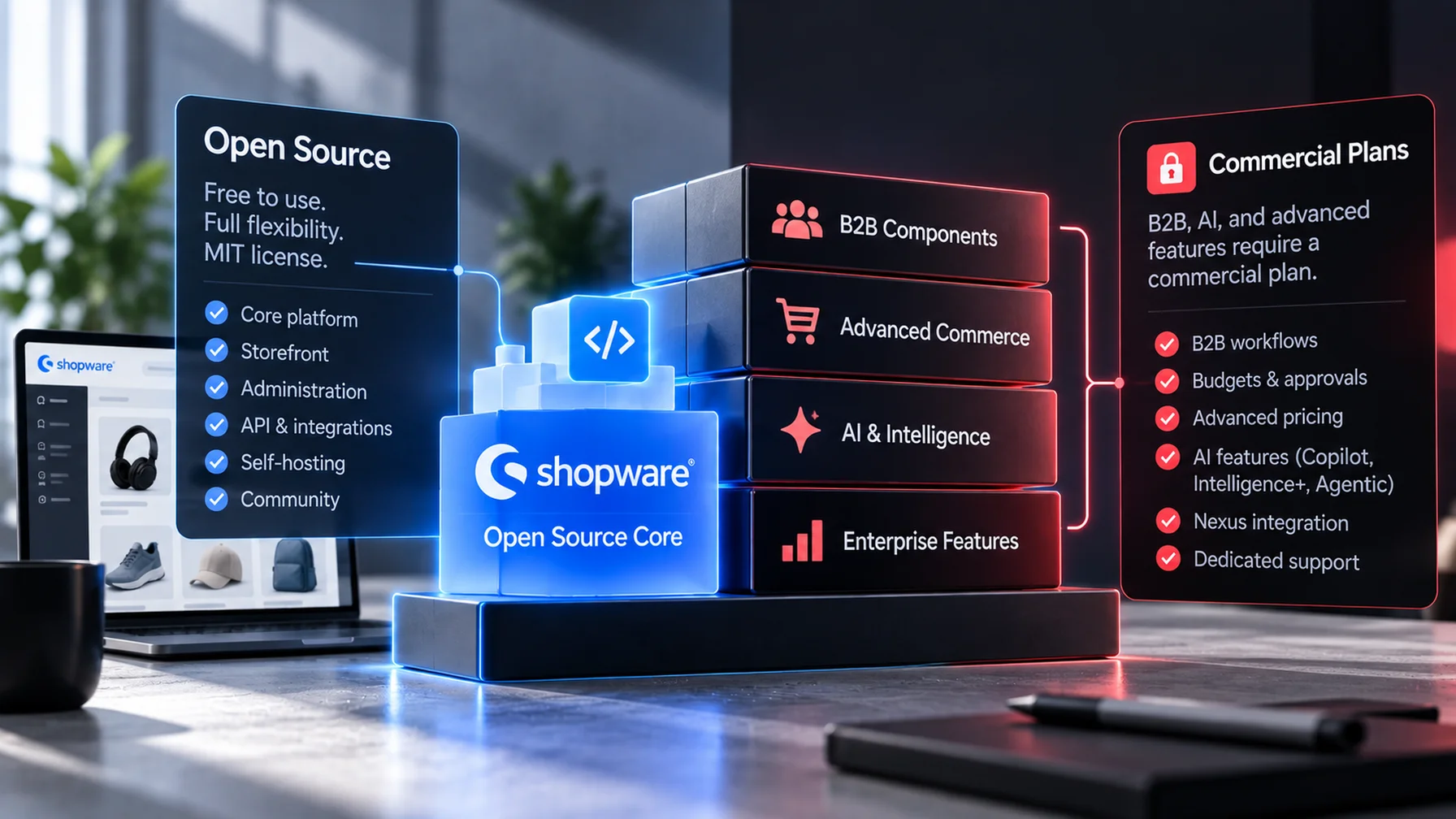
Is Shopware open source? Yes. And yet approvals, budgets and quotes need a contract. Shopware is an open-core model: the core is MIT-licensed, the B2B workflows sit in the commercial plans.
Shopware open source runs on an open core model, and if you're in B2B, that distinction matters. The open source benefits are real: auditability, self-hosting, integration freedom, and the ability to exit. They apply to the core. For the features sitting on top, contracts apply.
This article draws the line between what's open and what's proprietary, explains the Fair Usage Policy, and walks through what actually happens when you cancel a plan.
Shopware Open Source: Open Core, MIT Kernel, B2B Limits
What's MIT-licensed in Shopware and what lives in the Commercial Plugin
The Fair Usage Policy: the rule, the rationale, and what it means for your planning
Which open source benefits genuinely apply in B2B
Exit scenarios and a comparison with Magento and Shopify
Open Core, Defined
Open core is a business model where the software's foundation is released under an open source licence, while advanced features are licensed commercially. Shopware follows this model: the Community Edition is the MIT-licensed open source core — free to download and use, according to Shopware's pricing page. All paid plans build on top of it.
The MIT licence permits use, modification, redistribution, and commercial deployment without any copyleft obligations. The source code is on GitHub. That's open source, no strings attached.
What's Open and What Isn't
MIT-licensed: Core, Storefront, Administration, Store API and Admin API, Plugin and App System, Rule Builder, Flow Builder, Shopping Experiences, product variants, Sales Channels, Import/Export, multi-language and multi-currency support.
Commercial, delivered through paid plans: Shopware Intelligence and Copilot, 3D features, Publisher, and extended Flow Builder actions. From Evolve onwards, the B2B Components: roles and permissions, quotes, quick order, order lists, organisational units, budgets, Sales Agent, and customer-specific catalogues. Customer-specific pricing, Multi-Inventory, Subscriptions, and Digital Sales Rooms are Beyond-exclusive.
In practice: a B2B shop on the Community Edition gets customer groups, net and gross pricing, and the Rule Builder. It does not get approvals, budgets, or quotes — unless you build them yourself or use third-party plugins.
The Fair Usage Policy
Since March 2025, Shopware's policy is: the Community Edition is free up to one million euros in gross merchandise value per year. Above that, Shopware expects you to move to a paid plan. GMV is tracked through the Shopware Account — the same account you need for Store access and plugin licences anyway.
The rule has been controversial in the community. A thread in the Shopware forum with several hundred replies shows merchants pushing back on GMV tracking via terms and conditions and on the way it's bundled with the Commercial Plugin. Shopware's position: continued development of the free core has to be funded somehow.
For planning purposes, the takeaway is straightforward: if you're running the Community Edition and approaching seven figures in GMV, budget for a plan upgrade before Shopware asks you to make the switch. The MIT licence on the code isn't affected — the policy is tied to the account and Store access, not the codebase.
Which Open Source Benefits Actually Hold in B2B
Open source advantages are often described in abstract terms. In B2B they're concrete, because B2B processes rarely follow the standard playbook and because the data flowing through a shop is business-critical: contract pricing, customer hierarchies, order histories.
Digital sovereignty and auditability. The core is inspectable. For security audits, ISO certifications, and industry-specific compliance requirements, that's a genuine advantage over closed SaaS systems where you never see the code. What digital sovereignty means for a platform is really a decision across three dimensions: code, data, and infrastructure — open technology, European hosting, no dependency on someone else's roadmap.
Self-hosting and data ownership. Customer data, price lists, and order history stay in your infrastructure or with a European hosting provider. For regulated industries this is often the deciding factor; for everyone else it's a meaningful trust signal to business customers.
Process freedom. B2B means customer-specific approval workflows, multi-step authorisation, role and permission structures, and automated customer onboarding with ERP sync. An open core lets you extend where the standard stops, without waiting for a vendor to put it on their roadmap. At Shopware, that freedom applies fully to the core; the pre-built B2B workflows come with the plans.
Integration freedom. ERP for pricing and inventory, PIM for product data, CRM for customer relationships, accounting: you decide what connects and how, without API limits or record-count caps from a SaaS provider. The same applies to AI: which models you run, where they compute, and what data they access through open standards like the Model Context Protocol — that's your call, not the vendor's.
Predictable costs and community. With open source, you invest in hosting and development rather than revenue-linked licences; base costs stay stable and scale only where you need more resources. On top of that, an ecosystem of agencies, Store developers, and FriendsOfShopware fills the gaps the core doesn't cover. The Fair Usage Policy does soften the cost advantage once you cross the €1M GMV mark — factor that into every projection.
The flip side: operations, updates, and know-how sit with you. The Community Edition doesn't run in the Shopware Cloud; setup and maintenance are your responsibility. That takes a team or a partner — it's the price of independence.
Exit Scenario: What Actually Happens When You Cancel
Run the scenario. You cancel Evolve. The core keeps running. Your theme keeps running. Your own plugins keep running. The B2B Components do not keep running — they come through the Commercial Plugin, which is tied to your plan. Approvals, budgets, and quotes are gone; you need to export the associated data before you pull the plug.
This leads to an architecture principle we also list as a selection criterion in our replatforming guide: keep business-critical logic that you want to own long-term in your own plugins or integrations. Use plan features for standard processes you could replace if needed. That's not an argument against Evolve — it's an argument for building deliberately.
Comparison: Shopware, Magento, Shopify
Magento Open Source is also free, with the B2B module sitting exclusively inside Adobe Commerce. Adobe has shifted its focus to the cloud service; Mage-OS carries the open source line forward as a community fork. The open core model is structurally identical to Shopware's, and the commercial cut is drawn in roughly the same place.
Shopify publishes no source code. Everything you build there stays there. For standard processes that's not a problem; for exit capability it is.
Recommendations
Before choosing an edition, map which B2B features you need and whether they live in the core, Evolve, or Beyond.
Budget for a plan upgrade if you're running the Community Edition and heading towards €1M in GMV.
Keep business-critical logic in your own plugins or integrations — don't rely exclusively on plan features for it.
Document which data you'd need to export before cancelling a plan.
Use the openness of the core actively: code reviews, security audits, custom integrations.
Conclusion
Shopware open source is the real deal — and it's open core. The foundation is MIT-licensed, freely usable, and auditable. The B2B workflows sit in the paid plans, and the Fair Usage Policy caps free use by revenue.
For B2B decision-makers, that's not a problem as long as you know the setup. The open source advantages hold for architecture, data, and integrations. For process features, the contract governs.
The model will keep shifting toward plans; the Beyond-exclusive features point in that direction. All the more reason to know exactly what you own.
If you're planning a B2B project on Shopware and want clarity on what to build yourself versus what to licence, let's talk. As a Shopware agency, we've been building on open platforms for years and know both sides of that line.
FAQ
Is Shopware 6 open source?
Yes. The Shopware 6 core is MIT-licensed — freely downloadable, modifiable, and commercially usable. Advanced features, including the B2B Components, are part of the paid plans.
What is the Shopware Fair Usage Policy?
A rule introduced in 2025 that allows free use of the Community Edition up to one million euros in GMV per year. Above that threshold, Shopware expects you to move to a paid plan. GMV is tracked through the Shopware Account.
Which B2B features are included in the Community Edition?
Customer groups, net and gross pricing, Rule Builder, and Sales Channels. Approvals, budgets, quotes, organisational units, and Sales Agent are part of the B2B Components, available from Evolve onwards.
What happens when I cancel my Shopware plan?
The core, your theme, and your own plugins keep running. Plan features, including the B2B Components, are no longer available. Export any associated data before you cancel. Your contract terms apply.
Does Shopware create vendor lock-in?
Not for the core — it's open source and self-hostable. For plan features, yes, within the scope of your contract. Keeping critical logic in your own plugins keeps your options open.