Shopify B2B: What It Covers and Where Your ERP Takes Over

 AI generated
Shopify B2B offers company accounts, catalogs and payment terms on every plan. What only Shopify Plus can do and which tasks stay with your ERP.
Many people still see Shopify as a platform for brands selling to consumers. Yet Shopify B2B now includes company accounts, price lists and payment terms, on every plan. So the real question is a different one: which B2B logic does Shopify handle itself, and where does your ERP take over?
If you separate the two cleanly before the project starts, you avoid costly detours. If you don't, you end up building pricing logic twice and maintaining it in two places.
At a glance:
What Shopify B2B is and which features it includes
What only Shopify Plus can do
Which tasks stay with the ERP
When Shopify fits your B2B business
What is Shopify B2B?
Shopify B2B refers to the features you use to sell to business customers on Shopify. At its core is the company profile: a company has locations and buyers with their own permissions. You assign catalogs, prices and payment terms to each location.
According to Shopify, all four plans (Basic, Grow, Advanced and Plus) offer company profiles, wholesale pricing and self-service ordering for buyers. That means you can run B2B and B2C in the same shop instead of setting up a second one.
The B2B features Shopify includes
Company profiles: companies, locations and buyers with their own permissions.
Catalogs: product selection and prices per customer group.
Payment terms: invoice payment with net terms, including reminders.
Quantity rules and volume pricing: minimums, maximums, purchase increments and volume discounts.
B2B checkout: reorders, customer PO numbers and draft orders prepared by your sales team.
What only Shopify Plus can do
The main limit is catalogs. According to Shopify, Basic, Grow and Advanced allow up to three active catalogs across all B2B markets combined. Plus allows unlimited catalogs and lets you assign them directly to individual companies or locations.
Plus also adds advanced payment options: deposits, partial payments and payment per shipment. And if you have custom pricing or discount logic built as a custom app with Shopify Functions, that also requires Plus according to Shopify.
In practice: a wholesaler with a few price groups can work with Advanced. If you need customer-specific prices for many companies, you'll end up on Shopify Plus.
Where the ERP takes over
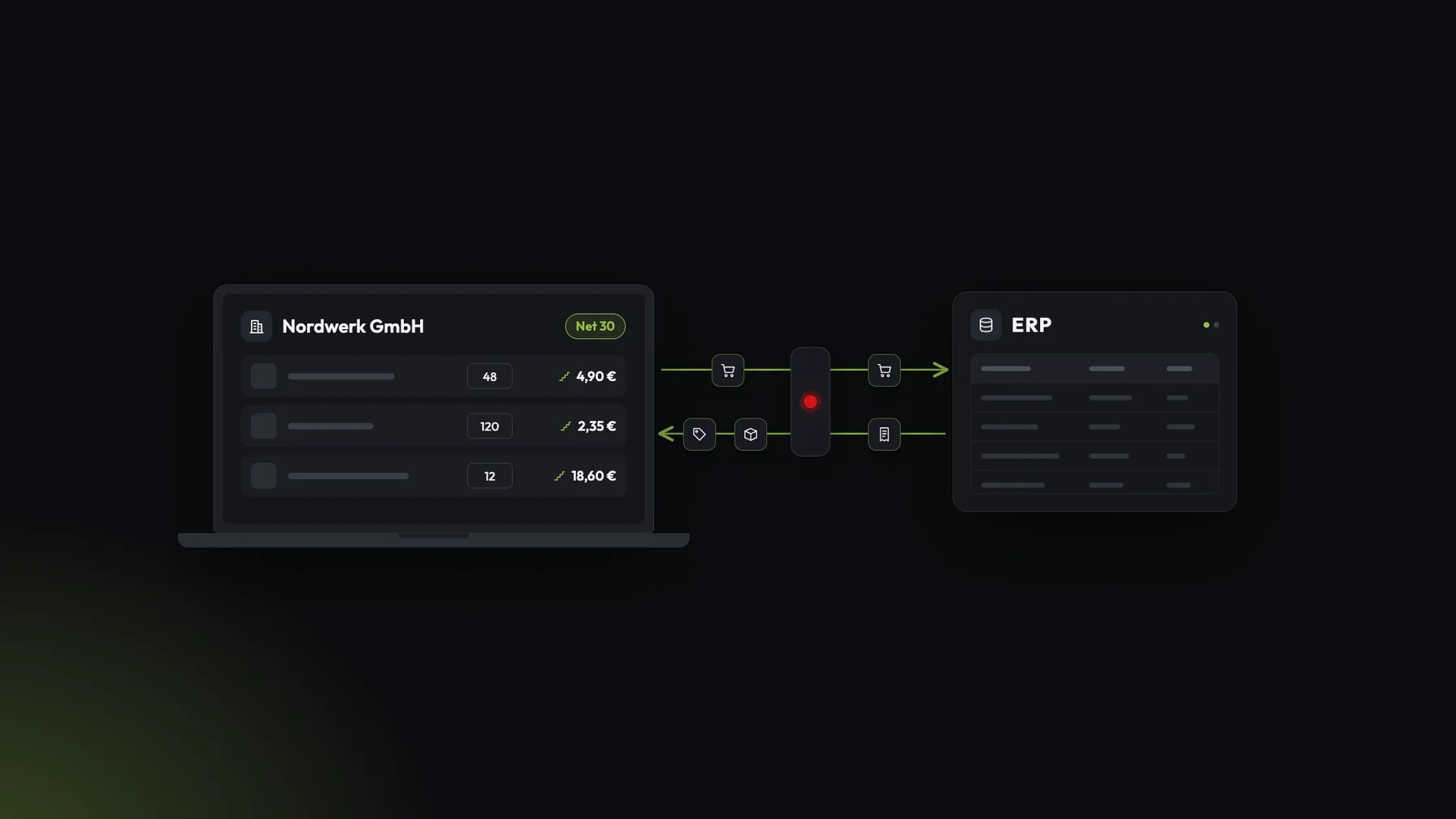
In B2B, the ERP is usually the source of truth for customers, terms, stock and invoices. Shopify is the channel your customers order through. That leads to a clear split of tasks:
Master data and terms are created in the ERP and synced to Shopify.
Orders flow from Shopify back to the ERP, where they're processed.
Availability, delivery status and invoices come from the ERP and appear in the customer account.
Through its Global ERP Program, Shopify offers prebuilt connectors, for example for NetSuite, Acumatica, Brightpearl, Microsoft Dynamics 365 Business Central and Infor. Whether a connector fits your plan and processes needs checking case by case. For SAP or heavily customised systems, a Shopify agency usually builds the integration for the specific project.
Our recommendation: decide which system owns which data before you choose features. Prices calculated in the ERP shouldn't be rebuilt in Shopify as well.
What this means for your team
B2B on Shopify mainly changes how your sales team works. Repeat orders run through the customer account, which frees up inside sales for advice. Draft orders let your team prepare quotes that customers complete themselves.
At the same time, you need clear ownership: who maintains catalogs, who owns the ERP interface, who manages company accounts? Without that, price differences between shop and invoice appear quickly.
How to check whether Shopify B2B fits
Write down your pricing logic. How many price groups are there, are there customer-specific prices, how are discounts calculated?
Define data ownership. Which data does the ERP own, and which does Shopify? Capture it in a simple matrix.
Choose the plan. More than three active catalogs, deposits or custom Functions mean Plus.
Test the integration early. Use a prototype to check that orders, prices and stock flow reliably between ERP and Shopify.
Conclusion: Shopify B2B works well when tasks are clearly split
Shopify B2B covers the standards of business commerce: company accounts, catalogs, payment terms and quantity rules. For many wholesalers and manufacturers, that's enough, especially if B2B and B2C should run in one shop.
It gets complex with customer-specific prices, many catalogs and deep ERP processes. Then your plan and integration decide whether the project succeeds.
If you define the split between Shopify and ERP early, you get a shop that works for customers and sales alike.
Frequently asked questions
Can Shopify do B2B?
Yes. According to Shopify, all plans offer company profiles, wholesale pricing, payment terms and self-service ordering for buyers. Plus adds unlimited catalogs, direct catalog assignment and advanced payment options.
Do I need Shopify Plus for B2B?
Not necessarily. With up to three active catalogs, Basic, Grow or Advanced are enough. For many customer-specific price lists, deposits or custom apps with Shopify Functions, you need Plus.
How do I connect Shopify to my ERP?
Through a prebuilt connector, for example from Shopify's Global ERP Program, or through a custom API integration. The key is to decide upfront which system owns customers, prices and stock.
Can I run B2B and B2C in one Shopify store?
Yes. After logging in, business customers see their catalogs, prices and payment terms, while consumers see the regular shop. That way, you maintain products and content only once.