Shopping on Autopilot: Why Agentic Commerce is the Next Frontier

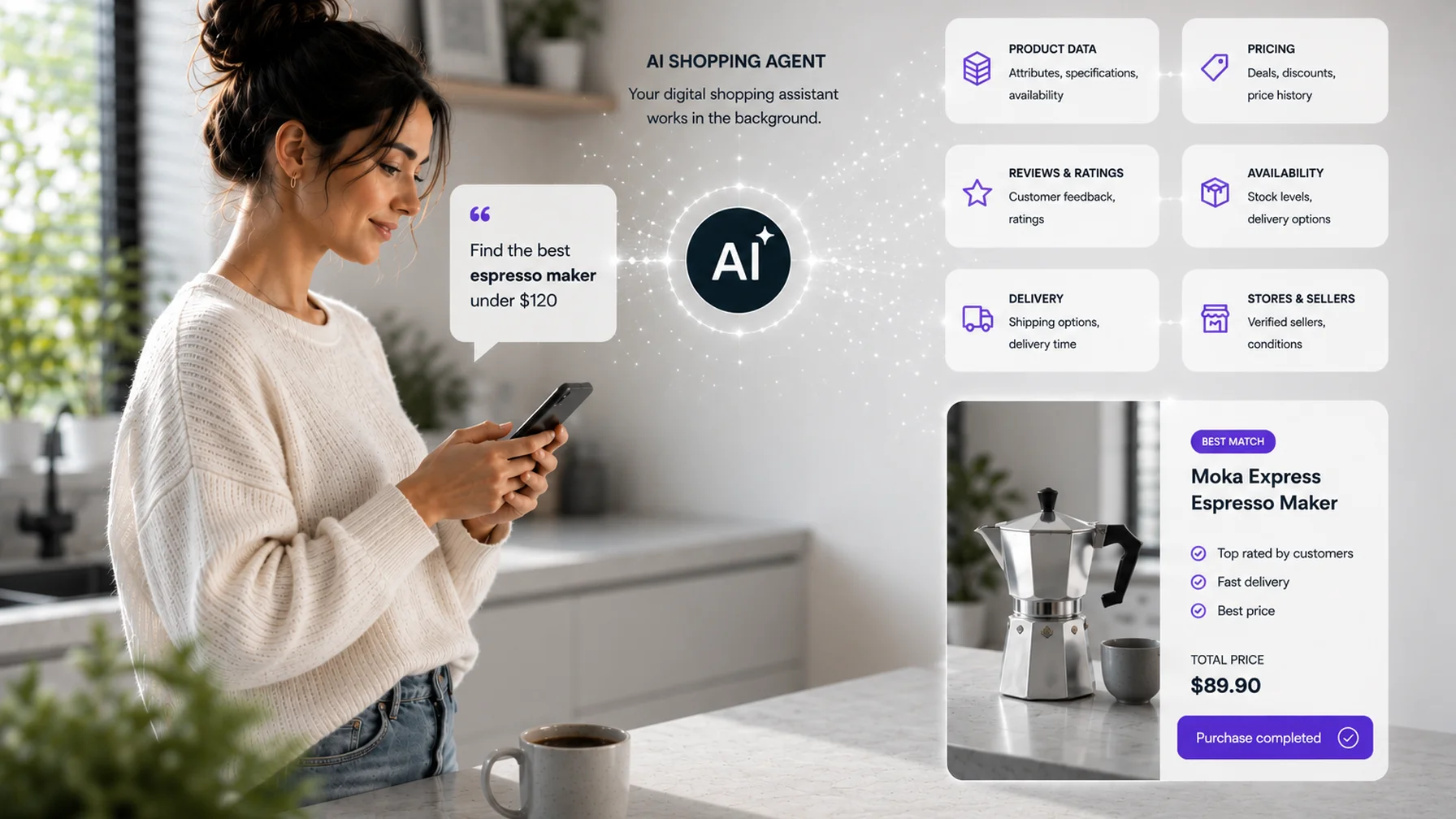
Prepare your business for a world where AI agents aren't just assistants - they’re the customers. Discover how Agentic Commerce is shifting the digital journey from UI-driven clicks to data-driven intent.
Understanding Agentic Commerce: Beyond the Webshop
Agentic Commerce represents the next evolution of digital trade: a world where autonomous AI agents actively participate in, or entirely manage, the purchasing process.
While traditional e-commerce is built for human eyes - focusing on layouts, buttons, and visual cues - Agentic Commerce is built for machine-to-machine interaction.
What does an "AI Agent" look like in the wild?
Personal Shopping Agents: AI that manages a user’s style preferences and budget.
Auto-Replenishment Systems: Smart devices that re-order supplies based on real-time consumption.
Predictive Advisors: AI that finds the "best running shoes under €150" by scanning thousands of data points in seconds.
In this new reality, the user provides the intent ("Find me a durable tent for Patagonia"), and the agent handles the research, comparison, and execution. The customer journey is transforming from a User Interface (UI) experience into a System Interface experience.
From Search to Execution: A New Customer Journey
In a traditional journey, a human searches, compares, reads reviews, and navigates a checkout. In an agent-driven journey, the AI collapses these steps into a single background process.
The shift for retailers: While humans remain the primary focus for now, a new "shadow" target group is emerging: the AI Selection Agent. Your platform must now be optimized for two distinct audiences: the person seeking inspiration and the software seeking data.
The Three Roles of AI Agents in Commerce
1. The Shopping Assistant (Guidance)
This is the entry-level stage. AI assistants help humans navigate vast catalogs using natural language.
Strategic Asset: Your Product Data Model (PIM). AI can only recommend what it can understand. If your attributes are messy, your brand becomes invisible to the assistant.
2. The Selection Agent (Analysis)
Here, the agent moves from "finding" to "deciding." It evaluates price, delivery speed, and technical compatibility across multiple shops.
Strategic Asset: API Connectivity. Your shop must provide deep, semantic context—not just a price tag, but material specs and real-time availability—via standardized interfaces.
3. The Purchase Agent (Automation)
The final stage is full automation, particularly in B2B procurement or recurring household needs. The agent identifies the need and executes the transaction autonomously.
Strategic Asset: Machine-to-Machine (M2M) Infrastructure. Secure, stable, and fast checkout APIs that don't require a "human" click to finalize.
Why Architecture is the "New UX"
In the world of Agentic Commerce, the "frontend" isn't the only face of your company. Your API-first architecturebecomes your most important storefront.
To win over AI agents, commerce systems must move toward:
Deep Semantic Data: Moving beyond simple titles to structured, machine-readable specifications.
High-Performance APIs: Agents "shop" via code. If your API is slow or poorly documented, the agent will skip to a competitor.
Composable Flexibility: A headless setup allows you to feed data to agents without the "weight" of a traditional frontend getting in the way.
Opportunities and Risks in Agentic Commerce
Opportunities
Hyper-Efficiency: Ermöglicht nahezu sofortige Conversions durch Agenten mit hoher Kaufabsicht.
Mass Personalization: Liefert exakte Treffer basierend auf den spezifischen Anfragen der KI-Agenten.
New Markets: Erschließt neue Kundengruppen über IoT-Geräte und ganze KI-Ökosystem
Risks
Loss of Control: Marken verlieren den Einfluss auf die visuelle Wahrnehmung und das emotionale Erlebnis („Vibe“) der Customer Journey.
Price Transparency: KI-Agenten vergleichen Preise gnadenlos – wer den Mehrwert nicht datenbasiert klar kommuniziert, verliert gegen den günstigsten Anbieter.
API Competition: Der Erfolg hängt künftig genauso stark von der technischen Erreichbarkeit (APIs) ab wie von der eigentlichen Produktqualität.
How to Prepare Your Business Today
You don’t need a full "Agentic Stack" tomorrow, but you should lay the foundation now:
Clean Your Data: Treat your PIM as a strategic marketing tool. Structured data is the "language" of AI.
Go API-First: Ensure your commerce platform is decoupled (Headless) so agents can access your catalog directly.
Think Composable: Modular systems allow you to plug in AI-powered search and recommendation engines with ease.
Audit Your "Machine UX": Is your site easy for a crawler or an agent to understand? If not, you’re losing the customers of the future.
Conclusion: The Technological Foundation is the Strategy
Agentic Commerce is the ultimate test for your digital infrastructure. As AI agents take over the heavy lifting of the customer journey, the role of the online shop shifts from a visual catalog to an API-enabled platform.
A successful customer experience no longer happens just on the screen—it happens in the data exchange. Those who invest in clean data, flexible architectures, and robust APIs today will be the ones chosen by the AI agents of tomorrow.
Is your commerce platform ready for the age of AI?
Let’s explore your architecture, data structures, and API strategy together to ensure your brand stays visible in an automated world.