GEO vs. SEO: What’s the Difference and Why Your Shop Needs Both

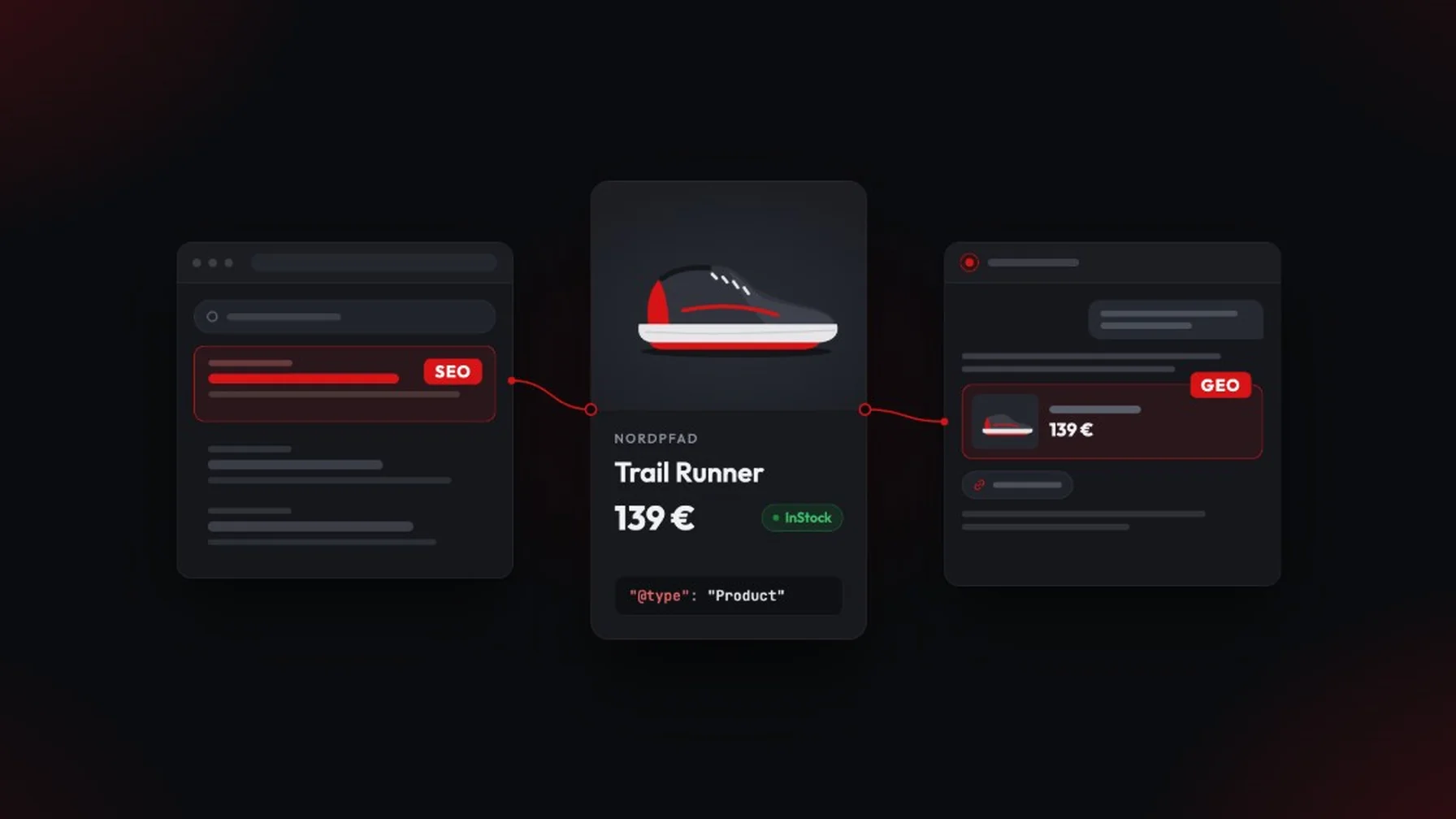 AI generated
GEO vs. SEO explained: how to make your online store visible in Google and AI answers, and what AI agents need to support shopping.
Your shop ranks well on Google, but doesn’t show up in ChatGPT? A strong ranking doesn’t guarantee a mention in an AI-generated answer. ChatGPT Search uses its own search mechanisms and sources; product recommendations also rely on additional product information.
The difference between GEO and SEO comes down to their goals: SEO improves a shop’s discoverability in search engines, while GEO aims to help AI systems understand its content and consider it in generated answers or cite it as a source. The tactics overlap. Google explicitly says established SEO fundamentals remain relevant to its AI search features, too.
For your commerce strategy, you should also assess separately whether products are visible and whether they can be bought. A product may appear in an AI answer while the purchase still takes place on the retailer’s website. That’s exactly the flow OpenAI currently describes on its merchant page.
In this article:
How SEO, GEO and Agentic Commerce differ.
Which content and technical foundations matter.
How to prioritize improvements in your shop.
What a free audit can check.
Why Google rankings are no longer enough
An AI answer engine combines information from sources to generate an answer, rather than displaying only a traditional list of results. Google AI Overviews and AI Mode pair these answers with links to further information. ChatGPT Search can also link to sources. So the idea that “Google shows links, while AI doesn’t” is too simplistic.
For AI search in e-commerce, this means checking more than rankings: assess whether your product range is represented accurately in relevant shopping and advice queries. Track citations, brand mentions and product recommendations separately. Each answers a different question: Is your content being used? Is your company being named? Is your offer being considered?
SEO, GEO and visibility in ChatGPT: what’s the difference?
SEO: help search engines find you
SEO stands for Search Engine Optimization. It covers tactics that improve the discoverability and ranking of web pages in search engines. For Google’s AI features, accessible pages, helpful content and internal links remain relevant. You don’t need a special “AI badge” for that.
GEO: make your content useful to AI
GEO stands for Generative Engine Optimization: tactics that make content and product information understandable and useful to AI-powered answer systems, so they can consider, cite or recommend it. The term describes an optimization goal, not a guaranteed placement.
“SEO for ChatGPT” is a common shorthand for this. It’s worth making a technical distinction: OpenAI uses OAI-SearchBot for its search feature. GPTBot serves a different purpose: it may be used to train models. You can set access rules for each bot independently.
Agentic Commerce: enable agents to take action
Agentic Commerce is commerce in which AI agents search for or compare products and, if the platform and checkout support it, carry out purchases on a customer’s behalf. Agentic Readiness describes a shop’s ability to be discovered, read by machines and used in supported workflows.
Layer | SEO | GEO | Agentic Commerce |
|---|---|---|---|
Goal | Discoverability in search engines | Inclusion in AI-generated answers | Supported purchasing actions |
Focus | Content, links and technology | Clear, reliable information | Product data and usable purchasing processes |
Intended outcome | Visibility and visits | Citation or recommendation | An action, potentially through to an order |
The table separates the goals, not the systems: search, generated answers and shopping features can coexist on the same platform.
The technology behind it: access and consistent data
Crawl access means automated programs are allowed to retrieve pages and can reach them technically. For ChatGPT Search, OpenAI recommends allowing OAI-SearchBot and checking for blocks imposed by your hosting provider or security services. That’s why checking robots.txt alone isn’t enough to test access.
Structured data makes information machine-readable, for example by describing a product and its offer with the Schema.org types Product and Offer. For shopping experiences, Google recommends including product markup in the initial HTML wherever possible. Dynamically generated information may be processed less reliably, especially when prices and stock levels change.
Product feeds send catalog information to platforms. OpenAI describes direct feeds as a way to provide more accurate and up-to-date product information. Check access and supported shopping features separately for your market and platform.
Our architecture recommendation: supply product pages, structured data and feeds from aligned data sources. Don’t maintain the same inventory independently across multiple systems.
What changes for your team
Treat GEO for online stores as a shared responsibility across e-commerce, content and development. Decide who owns product attributes, who checks technical access and who resolves conflicting information.
For B2B shops, make one additional decision: which information should be publicly available, and which should remain customer-specific? A public product description can support research. Individual terms and ordering permissions should remain part of a controlled process.
When measuring results, keep traditional search performance, AI referrals and actual inquiries separate. A mention isn’t a business outcome on its own. Track whether it leads to qualified visits or contacts, too.
Practical example: being found doesn’t mean being understood
A deliberately simplified example: a spare-parts shop has a category page that’s easy to find. But the key compatibility information only appears after an interactive selection. A page retrieved without that interaction won’t include it.
If the product feed also contains outdated stock information, the sources contradict one another. Even a mention of the shop then won’t reliably tell shoppers whether the part fits or is available.
Our suggested check: for a representative product, compare the delivered page content, markup and feed. Then test separately whether a supported purchasing flow handles the right variants and permissions. This turns “we need GEO” into a concrete action list.
GEO vs. SEO: what to change in your shop
Test access in practice. Check server responses and security rules for relevant search bots, not just robots.txt. Document specific blocked URLs. OpenAI explicitly lists access via its published bot IP addresses as a requirement.
Answer the questions that drive buying decisions. Add clear information about product use, compatibility and limitations to product pages. Use real questions from sales and support as the basis for content.
Reconcile product data. Compare price, currency, variant and availability across the page, markup and feed. Define a single source of truth and a process for resolving discrepancies. These fields are among the documented product attributes for shopping experiences.
Monitor visibility over time. Test relevant customer questions using documented wording and dates. Track accurate citations and product mentions separately; don’t infer lasting placement from a single answer.
Free AI agent audit for your online store
creativestyle’s free Agentic Readiness Check reviews publicly accessible shop information without logging in or running JavaScript. It checks, among other things, robots.txt, sitemaps and structured data, then provides recommendations.
The assessment covers discoverability, readability and actionability. Use it as a starting point for prioritization. A technical check doesn’t prove that ChatGPT will recommend your shop, nor does it replace a complete order test on every AI platform.
Conclusion: plan GEO and SEO together, test them separately
Understanding the difference between GEO and SEO helps you set clear goals. GEO doesn’t replace SEO: strong technical and content SEO fundamentals still matter.
Our recommendation: connect content work and product data maintenance to a technical foundation you can test. That requires clear ownership and specific checks.
GEO doesn’t automatically make a shop purchasable through AI agents. That also requires suitable product data and a purchasing process that the relevant agent or platform can actually use.
Frequently asked questions
What is GEO, and how is it different from SEO?
GEO (Generative Engine Optimization) aims to get your content considered or cited in AI-generated answers, while SEO improves discoverability in search engines. The two share technical and content foundations.
How can I make my online store visible in ChatGPT?
Allow relevant search bots such as OAI-SearchBot to access your site and provide clear product information. Product feeds can help transfer data; OpenAI doesn’t guarantee a mention or placement.
Why doesn’t good SEO prove AI visibility?
A shop’s Google ranking alone can’t tell you whether it appears in AI answers. ChatGPT uses its own search mechanisms and product data, while Google integrates AI answers into its search experience.
How do I check whether AI bots can read my online store?
Check robots.txt, actual server responses and any security blocks. The Agentic Readiness Check adds a review of publicly accessible content without JavaScript.
What’s the difference between GEO and Agentic Commerce?
GEO concerns visibility in AI answers. Agentic Commerce involves actions in the shopping process; which actions are possible depends on the specific integration.